*I got hooked on the mythology thanks mainly to the series of books by Zecharia Sitchin. When I was young, I worked away from home in the week so I spent Mondays/Fridays on a really long train journey, I bought the 12th planet [11], read on the train and was hooked.
The land of Mesopotamia, which translates to ‘land between the rivers’, has been a subject of fascination for centuries, with its rich history and mythology captivating the imagination of people around the world. From the epic tales of Gilgamesh to the mythological creatures that roamed the ancient world, Mesopotamian mythology is a treasure trove of stories, legends, and historical significance. In this article, we will delve into the world of ancient Mesopotamian mythology, exploring its background, key themes, and significance, as well as analysing its implications and relevance to modern times. The purpose of this article is to provide an in-depth understanding of Mesopotamian mythology, its cultural and historical context, and its enduring impact on human civilisation.
To understand the mythology of ancient Mesopotamia, it is essential to provide some historical context. Mesopotamia, which corresponds to modern-day Iraq, Kuwait, and parts of Syria, Turkey, and Iran, was home to some of the earliest urban civilisations, including the Sumerians, Akkadians, Babylonians, and Assyrians. The region’s unique geography, with the Tigris and Euphrates rivers flowing through it, made it an ideal place for agriculture and settlement. The earliest Mesopotamian civilisations date back to around 4500 BCE, with the Sumerians being the first to develop a writing system, known as cuneiform, around 3200 BCE. This writing system allowed the Sumerians to record their myths, legends, and historical events, which were later adopted and adapted by other Mesopotamian cultures.
One of the most significant contributions of Mesopotamian mythology is the epic tale of Gilgamesh, which is considered to be one of the earliest surviving works of literature. The Epic of Gilgamesh, which dates back to around 2100 BCE, tells the story of Gilgamesh, a king of Uruk, who embarks on a quest for immortality after the death of his friend Enkidu. The epic poem explores themes of friendship, love, loss, and the human condition, and its influence can be seen in later literary works, such as the Iliad and the Odyssey. As the Assyriologist, Andrew George, notes, “The Epic of Gilgamesh is a masterpiece of ancient Mesopotamian literature, and its influence can be seen in the literature of many other cultures” [1]. The epic tale of Gilgamesh has been widely studied and translated, and its themes and motifs continue to inspire artists, writers, and scholars to this day.
Mesopotamian mythology is also characterised by its pantheon of gods and goddesses, each with their own distinct powers and attributes. The Sumerians, for example, worshipped a range of gods, including Anu, the sky god, Enlil, the air god, and Inanna, the goddess of love and war. The Babylonians, on the other hand, worshipped Marduk, the patron god of Babylon, who was often depicted as a dragon-slaying hero. These gods and goddesses played a crucial role in Mesopotamian mythology, often intervening in human affairs and shaping the course of history. As the historian, Jean Bottero, notes, “The Mesopotamian gods were not just distant, omnipotent beings, but were often depicted as having human-like qualities, such as emotions, desires, and flaws” [2]. The Mesopotamian pantheon of gods and goddesses has had a lasting impact on the development of Western mythology, with many of its themes and motifs being adopted and adapted by later cultures.
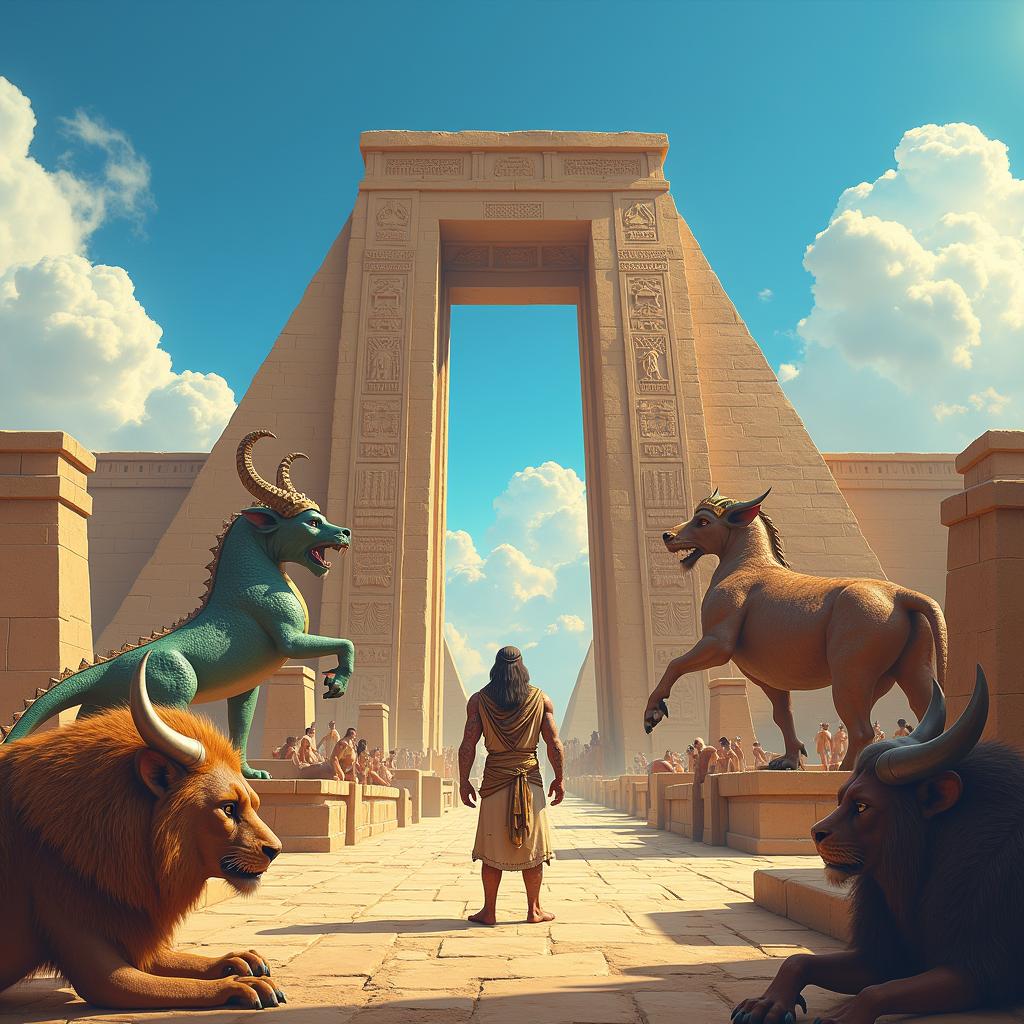
In addition to its epic tales and pantheon of gods, Mesopotamian mythology is also notable for its mythological creatures, such as dragons, demons, and monsters. The most famous of these creatures is perhaps the Mušḫuššu, a dragon-like creature with the body of a lion and the head of an eagle, which was often depicted in Mesopotamian art and literature. These creatures played a significant role in Mesopotamian mythology, often serving as symbols of good and evil, or as agents of the gods. As the archaeologist, Paul-Alain Beaulieu, notes, “The Mesopotamian mythological creatures were often used to explain natural phenomena, such as earthquakes, floods, and droughts, and to provide a sense of order and meaning in a chaotic world” [3]. The Mesopotamian mythological creatures have had a lasting impact on the development of Western mythology, with many of its themes and motifs being adopted and adapted by later cultures.
The significance of Mesopotamian mythology cannot be overstated. Not only did it provide a framework for understanding the world and the human condition, but it also played a crucial role in shaping the cultural, social, and political institutions of ancient Mesopotamia. The myths and legends of Mesopotamia were often used to justify the rule of kings and the power of the gods, and to provide a sense of continuity and tradition in a rapidly changing world. As the historian, Marc Van De Mieroop, notes, “Mesopotamian mythology was not just a collection of stories, but a way of understanding the world and the human condition, and of providing a sense of meaning and purpose” [4]. The significance of Mesopotamian mythology can be seen in its enduring impact on Western culture, with many of its themes and motifs being adopted and adapted by later cultures.
In analysing the implications of Mesopotamian mythology, it is clear that its influence can be seen in many areas of human culture, from literature and art to religion and politics. The epic tale of Gilgamesh, for example, has been widely studied and translated, and its themes and motifs continue to inspire artists, writers, and scholars to this day. The Mesopotamian pantheon of gods and goddesses has also had a lasting impact on the development of Western mythology, with many of its themes and motifs being adopted and adapted by later cultures. As the scholar, Thorkild Jacobsen, notes, “Mesopotamian mythology is a rich and complex system, which reflects the cultural, social, and political institutions of ancient Mesopotamia, and which continues to inspire and influence human culture to this day” [5]. The implications of Mesopotamian mythology are far-reaching, and its study continues to be an important area of research and inquiry.
In conclusion, ancient Mesopotamian mythology is a rich and complex system, which reflects the cultural, social, and political institutions of ancient Mesopotamia. From the epic tale of Gilgamesh to the mythological creatures that roamed the ancient world, Mesopotamian mythology is a treasure trove of stories, legends, and historical significance. The significance of Mesopotamian mythology cannot be overstated, and its influence can be seen in many areas of human culture, from literature and art to religion and politics. As we reflect on the insights gained from this article, we are left with a profound appreciation for the enduring power of Mesopotamian mythology, and a sense of wonder at the rich cultural heritage of ancient Mesopotamia. As the scholar, Jeremy Black, notes, “Mesopotamian mythology is a reminder of the power of human imagination and creativity, and of the enduring significance of ancient cultures in shaping our modern world” [6]. And so, we are left to ponder the question: what can we learn from the myths and legends of ancient Mesopotamia, and how can we apply these lessons to our own lives and cultures?
References and Further Reading:
- George, A. (2003). The Epic of Gilgamesh. Penguin Books.
- Bottero, J. (1992). Mesopotamia: Writing, Reasoning, and the Gods. University of Chicago Press.
- Beaulieu, P. (2003). The Pantheon of Uruk During the Neo-Babylonian Period. Brill.
- Van De Mieroop, M. (2004). A History of the Ancient Near East. Wiley-Blackwell.
- Jacobsen, T. (1976). The Treasures of Darkness: A History of Mesopotamian Religion. Yale University Press.
- Black, J. (2004). The Literature of Ancient Sumer. Oxford University Press.
- Kramer, S. (1963). The Sumerians: Their History, Culture, and Character. University of Chicago Press.
- Postgate, J. (1992). Early Mesopotamia: Society and Economy at the Dawn of History. Routledge.
- Roux, G. (1992). Ancient Iraq. Penguin Books.
- Snell, D. (1997). Life in the Ancient Near East. Yale University Press.
- Sitchin, Z. (1976), 12th Planet: Book I of the Earth Chronicles, Mass Market Paperback





 Conversations with AI
Leave a comment