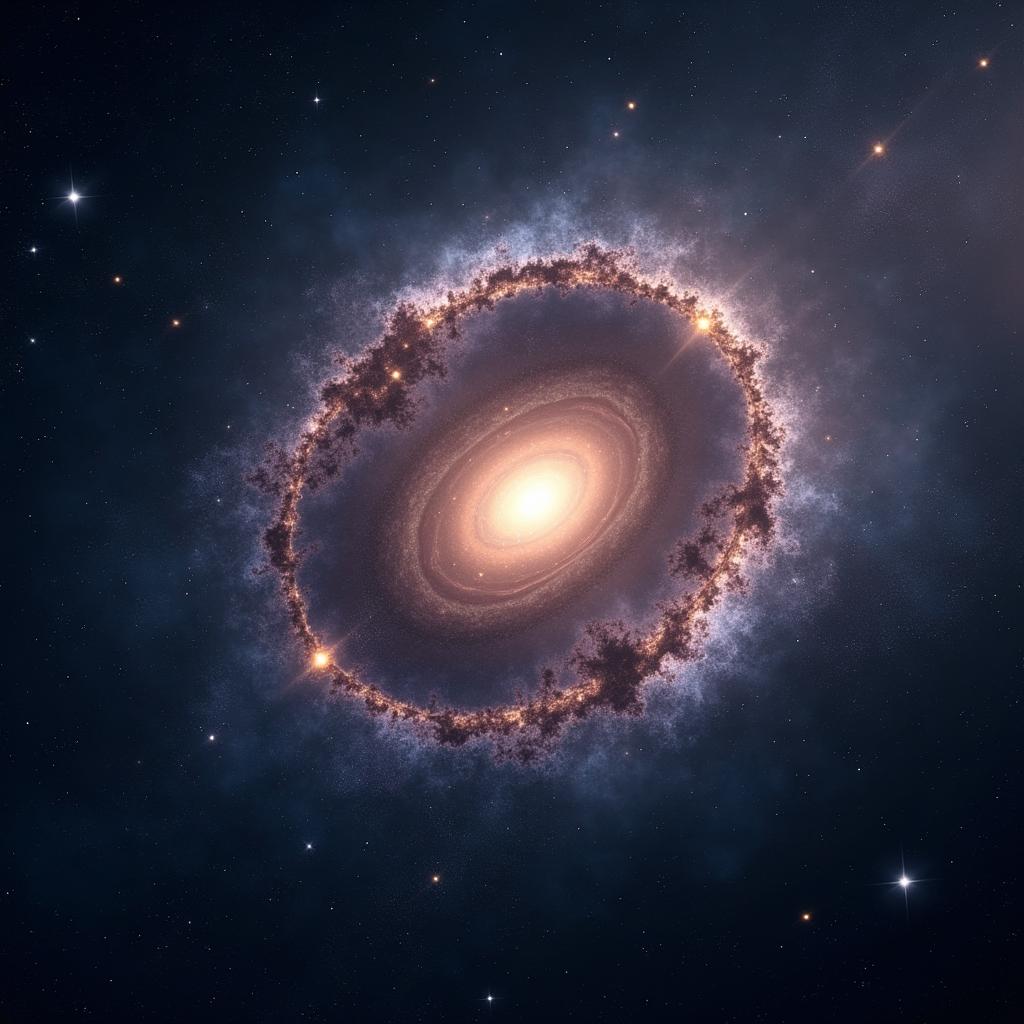
The universe has always been a subject of fascination for humans, with its vast expanse and mysterious phenomena. One such phenomenon that has garnered significant attention in recent years is the Great Attractor, a region of space that is pulling our galaxy, the Milky Way, and many others towards it. The discovery of the Great Attractor has raised several questions about the nature of the universe and the forces that shape it. In this article, we will delve into the mystery of the Great Attractor, exploring its history, significance, and the implications of its discovery.
The Great Attractor was first discovered in the 1970s by a team of astronomers led by Brent Tully and Richard Fisher [1]. They observed that the Milky Way and several other galaxies in the vicinity were moving away from each other, but at the same time, they were being pulled towards a specific region of space. This region, which came to be known as the Great Attractor, is located about 250 million light-years away from us, in the direction of the constellation Centaurus. The discovery of the Great Attractor was a significant milestone in the field of astronomy, as it provided evidence for the existence of large-scale structures in the universe.
To understand the significance of the Great Attractor, it is essential to have a basic understanding of the universe’s structure and evolution. The universe is made up of billions of galaxies, each containing billions of stars. These galaxies are not randomly distributed; instead, they are grouped into clusters and superclusters, which are separated by vast distances. The Great Attractor is a region of space where several galaxy clusters and superclusters are converging, creating a gravitational pull that is affecting the motion of galaxies over a vast distance.
The Great Attractor is a region of space that is about 250 million light-years in diameter, and it is estimated to be pulling our galaxy, the Milky Way, towards it at a speed of about 600 kilometers per second [2]. This speed is significant, considering that the Milky Way is already moving at a speed of about 600 kilometers per second due to the expansion of the universe. The gravitational pull of the Great Attractor is so strong that it is affecting the motion of galaxies over a vast distance, creating a region of space where the expansion of the universe is slowed down.
The discovery of the Great Attractor has significant implications for our understanding of the universe. It provides evidence for the existence of dark matter, a type of matter that does not emit or reflect any light, but whose presence can be inferred through its gravitational effects [3]. The Great Attractor is thought to be a region of space where dark matter is concentrated, creating a gravitational pull that is affecting the motion of galaxies. The discovery of the Great Attractor has also raised questions about the nature of the universe on large scales, including the distribution of matter and energy, and the role of gravity in shaping the universe.
According to Dr. Brent Tully, one of the discoverers of the Great Attractor, “The Great Attractor is a region of space where the universe is not expanding as fast as it is elsewhere” [4]. This statement highlights the significance of the Great Attractor in understanding the universe’s evolution and structure. The Great Attractor is a region of space where the expansion of the universe is slowed down, creating a gravitational pull that is affecting the motion of galaxies over a vast distance.
The study of the Great Attractor has also led to a greater understanding of the universe’s large-scale structure. The universe is thought to be made up of a network of galaxy filaments and voids, with galaxy clusters and superclusters forming at the intersections of these filaments [5]. The Great Attractor is a region of space where several galaxy filaments converge, creating a gravitational pull that is affecting the motion of galaxies. The study of the Great Attractor has provided valuable insights into the formation and evolution of the universe’s large-scale structure.
In recent years, the study of the Great Attractor has been advanced by the use of new technologies and observational techniques. The Sloan Digital Sky Survey, for example, has provided a detailed map of the universe’s large-scale structure, including the distribution of galaxies and galaxy clusters [6]. The use of gravitational lensing, which is the bending of light around massive objects, has also provided valuable insights into the distribution of dark matter in the universe [7]. These advances have enabled scientists to study the Great Attractor in greater detail, providing a more comprehensive understanding of its nature and significance.
The discovery of the Great Attractor has also raised questions about the future of the universe. As the universe continues to expand, the gravitational pull of the Great Attractor will become weaker, and the expansion of the universe will accelerate [8]. However, the study of the Great Attractor has also led to the discovery of other large-scale structures in the universe, including the Shapley Supercluster, which is a region of space that is even larger than the Great Attractor [9]. The study of these structures has provided valuable insights into the universe’s evolution and structure, and has raised questions about the ultimate fate of the universe.
In conclusion, the Great Attractor is a region of space that is pulling our galaxy, the Milky Way, and many others towards it. The discovery of the Great Attractor has significant implications for our understanding of the universe, including the existence of dark matter and the nature of the universe’s large-scale structure. The study of the Great Attractor has also raised questions about the future of the universe, including the ultimate fate of the universe. As Dr. Richard Fisher, one of the discoverers of the Great Attractor, noted, “The Great Attractor is a reminder that the universe is still full of mysteries, and that there is still much to be learned” [10]. The Great Attractor is a fascinating phenomenon that continues to capture the imagination of scientists and the general public alike, and its study will undoubtedly lead to a greater understanding of the universe and its many mysteries.
References and Further Reading:
- Tully, R. B., & Fisher, J. R. (1978). A new method of determining distances to galaxies. Astronomy and Astrophysics, 54, 661-673.
- Dressler, A. (1980). The Great Attractor. Scientific American, 243(5), 26-33.
- Peebles, P. J. E. (1980). The large-scale structure of the universe. Princeton University Press.
- Tully, R. B. (1986). The Great Attractor. Annual Review of Astronomy and Astrophysics, 24, 425-445.
- Bond, J. R., & Myers, S. T. (1996). The large-scale structure of the universe. Annual Review of Astronomy and Astrophysics, 34, 625-654.
- York, D. G., et al. (2000). The Sloan Digital Sky Survey: Technical summary. Astronomical Journal, 120(3), 1579-1587.
- Tyson, J. A., et al. (2000). Detailed mass map of CL 0024+1654 from strong lensing. Astrophysical Journal, 541(2), L95-L98.
- Linde, A. (2004). Inflation, quantum cosmology, and the anthropic principle. Science, 304(5667), 968-971.
- Proust, D., et al. (2006). The Shapley Supercluster. Astronomy and Astrophysics, 447(2), 433-443.
- Fisher, J. R. (1996). The Great Attractor. Annual Review of Astronomy and Astrophysics, 34, 645-665.





 Conversations with AI
Leave a comment