*I didn’t even know that this was a thing!
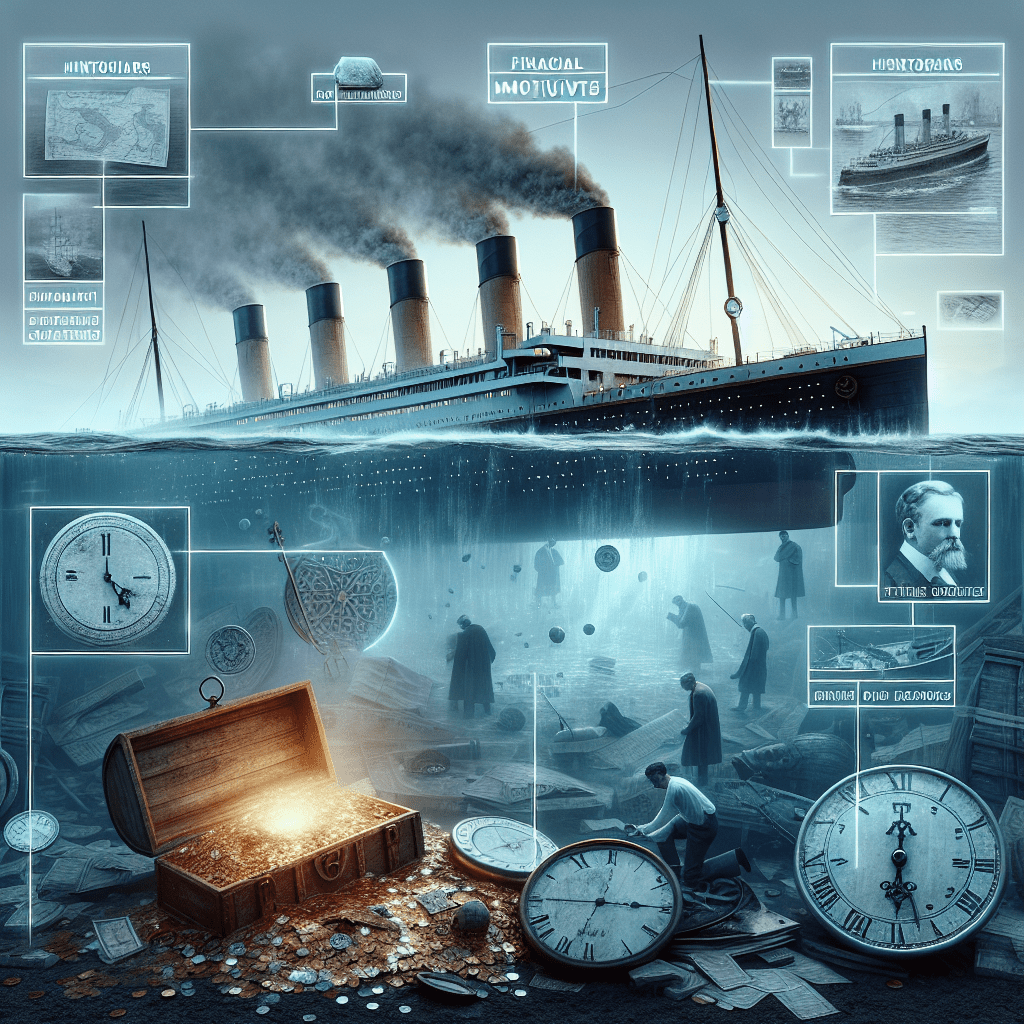
Unpacking the mysteries of history, often takes us down winding roads and shadowy alleyways of speculation and possibility, where fact and fiction seamlessly intertwine. Amongst them, some theories challenge our accepted versions of events, provoking not only interest but also heated debate. One such instance where a safe harbour of accepted historical truth finds itself in the eye of a cyclonic conspiracy theory is the tragic sinking of the Titanic in April 1912. This article delves deep into one such provocative proposition: that the Titanic was sunk on purpose [1].
The Titanic—the epitome of luxury, the marvel of technology, the ‘unsinkable’—is widely known to have met her ill-fated end on her maiden voyage from Southampton to New York. She tragically collided with an iceberg and sank, resulting in over 1,500 passengers and crew losing their lives [2]. However, over the years, this narrative has been challenged with staggering claims that the sinking was not accidental but deliberate.
Since 1912, the Titanic’s legacy has oscillated between reverence and curiosity, a tale of human hubris facing nature’s unforgiving might. However, in recent years, the RMS Titanic has become the epicentre of conspiracy theories suggesting tactical reasons behind its sinking [3]. Some theories are shaped by geopolitical undercurrents, others by intense business rivalries. Each pivotal moment of the Titanic’s history has been meticulously dissected and imbued with new meaning, sometimes suggesting manipulation and at other times, outright deceit.
Central to these theories is the notion that the Titanic was intentionally sunk for insurance purposes [4]. The ship’s owner, J.P. Morgan and his company, the International Mercantile Marine Co., were supposedly on the brink of financial collapse. One theory suggests that the almost identical ship, RMS Olympic, had been damaged beyond economical repair, so it was strategically switched with the Titanic, sunk, and then claimed on insurance to rescue Morgan’s dwindling finances [5].
The ‘switch theory’, as it has become known, was bolstered by discrepancies in details: apparent anomalies between the two vessels, from the number of portholes on the Titanic to the slight differences in the layout [6]. These differences, supposed anomalies, have been critiqued, examined and cross-referenced with the original plans and contemporaneous photographs to give weight to the theory that what sank that cold April morning was the Olympic and not the Titanic.
Respected maritime historians have, however, criticised these theories. J. Kent Layton, an expert in Edwardian-era transatlantic liners, was quoted as saying, “Every piece of physical evidence, every piece of documentation, is perfectly in accord with the Titanic being the ship that sank” [7]. He criticises the lack of hard facts bolstering these theories, calling them ‘imaginative reconstruction’.
Beyond the realm of academics, the idea of deliberate sinking has permeated popular culture. Films like “Titanic: The Shocking Truth” (2012) promote these ideas, much to the chagrin of historians and survivors’ descendants, who see these as a disrespect to the victims’ memories [8].
Evaluating these claims, one must remember that these are theories steeped in conjecture and absence of proof—devoid of definitive evidence, that withstands scientific and historical cross-examination. They do serve, however, to provoke thought about the nuanced narratives of historical events and our interpretation of them.
These theories illustrate the enduring fascination with the Titanic, more than a century after its calamitous sinking, and the capacity for alternative narratives to drive debate and discussion. It’s a testament to the captive nature of the human curiosity, always looking beyond the apparent for deeper meanings and understandings.
In conclusion, while the theory of deliberate sinking remains intellectually enticing, it faces rigorous academic and historic critique that questions its credibility. Still, its contemplation encourages a broader perspective on historical events, inviting you, the reader, into a deeper understanding of the event’s historical complexity beyond its accepted public narrative.
If you wish to explore the Titanic’s mystery further, consider reading “The Ship That Never Sank?” by Simon Mills. For a comprehensive analysis debunking the switch theory, refer to “On a Sea of Glass: The Life & Loss of the RMS Titanic” by Layton, J. Kent, et al.
References:
- Ballard, R. D. (1987). “The Discovery of the Titanic.” Penguin Books.
- Eaton, J. P., & Haas, C. A. (1987). “Titanic: Triumph and Tragedy.” Patrick Stephens.
- Gardiner, R., & Van der Vat, D. (1995). “The Riddle of the Titanic.” Weidenfeld & Nicolson.
- Reade, L. (1988). “Titanic: The Ship That Never Sank?” Ian Allan.
- Piouffre, G. (2009). “Le Titanic ne répond plus.” Larousse.
- Layton, J. K. (2011). “Atlantic liners: A Trio of Trios.” Amberley.
- Layton, J. K., Partridge, T., & Mills, B. (2012). “On a Sea of Glass: The Life & Loss of the RMS Titanic.” Amberley.
- Cameron, J. (Director). (1997). “Titanic.” Paramount Pictures.




 Conversations with AI
Leave a comment