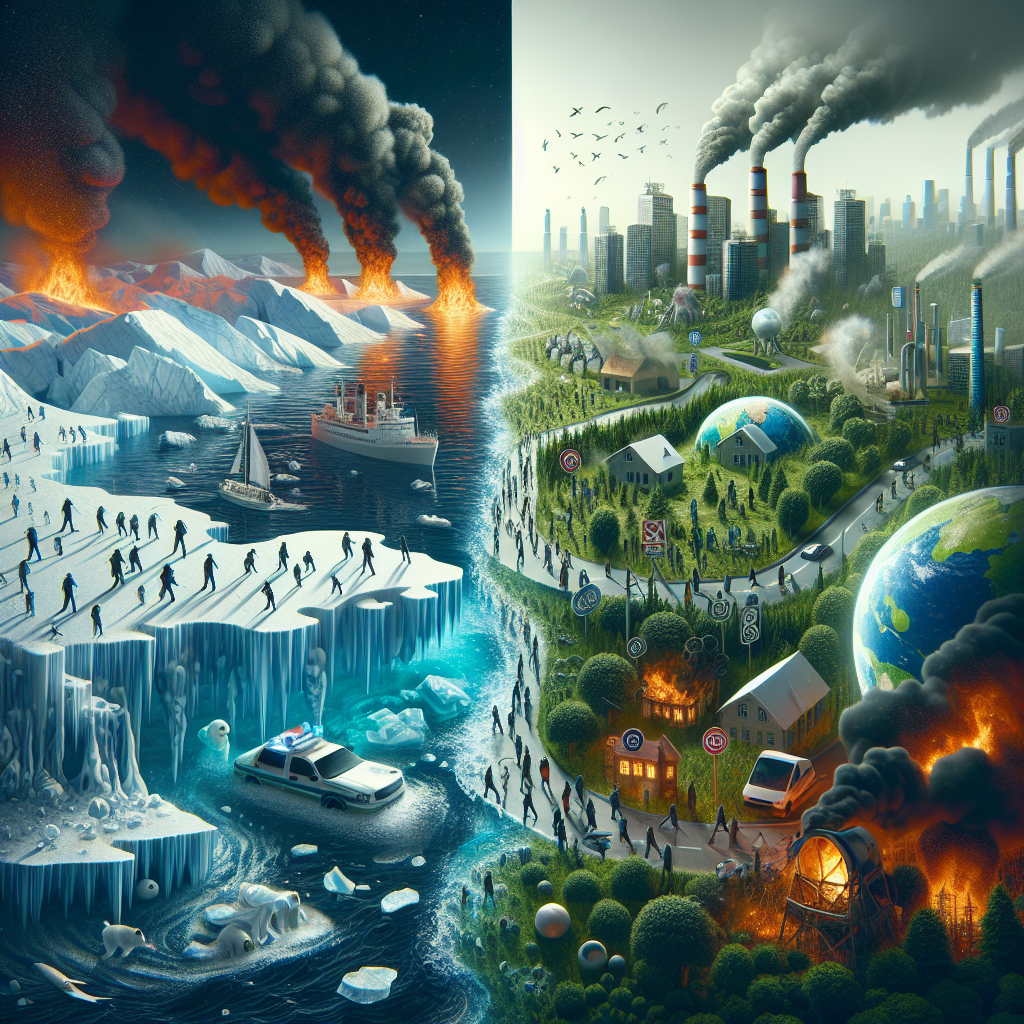
Climate change, a term that sparks both controversy and intrigue, has often been bestowed the limelight in heated debates of modern society. Is it nothing more than a fictitious tale fabricated for political ends? Or is it a dire reality, an ominous ticking time bomb set to wreak havoc on our existence? This article aims to delve deeper into the diverse dimensions of climate change, presenting an in-depth exploration to shed light on its reality and significance.
Examining the unit of time over the last century, we have been witnessing unambiguous evidence of warming occurring across the globe — a comprehensive inference drawn from multiple independent measurements of surface temperature [1]. Situating this in the larger perspective, geological evidence from the last hundred thousand years suggests that the earth’s climate has undergone dramatic changes, oscillating between glacial and interglacial periods as a result of variations in the earth’s orbit and tilt [2].
However, the contemporary trajectory of global warming is much steeper. According to the Intergovernmental Panel on Climate Change (IPCC), the planet’s mean surface temperature has risen by approximately 0.85°C between 1880 and 2012 [3]. This buffeting pace amplifies the concern, indicating that the phenomenon we are observing today is far from natural.
To understand this, we need to navigate intricate scientific domains that climatologists and planetary scientists have explored and examined. The greenhouse effect, where gases in the Earth’s atmosphere trap heat and prevent it from escaping into space, is a fundamental principle that governs the climate [4]. This scaffolding effect is amplified by human activities that increase the concentrations of greenhouse gases, primarily carbon dioxide and methane. As eloquently articulated by Dr. James Hansen, former director of NASA’s Goddard Institute for Space Studies, “The Earth’s climate has been remarkably stable for the past 7,000 years. If global warming isn’t kept in check, we will create a much different planet.” [5]
This human-induced factor has potentially dire implications for our planet’s future. As the eminent climate scientist, Dr. Michael E. Mann, observed, “We are already seeing dangerous weather extremes. And it’s only going to get worse.” [6] These pointed observations underscore the risk in dismissing climate change as a myth.
Analyzing the evidence supports the reality of anthropogenic climate change. But, it is essential to acknowledge that this issue and the discourse surrounding it is not without controversy. Skeptics argue that scientists manipulate or exaggerate data, casting doubt on the consensus view [7]. However, several independent investigations have refuted these claims, affirming the credibility of climate science [8].
The ramifications of climate change are manifold, from health crises spurred by heatwaves and disease-carrying insects to economic challenges posed by draughts and floods [9]. Moreover, there are potential security risks; water and food shortages could lead to social unrest and forced migrations [10].
In conclusion, while the subjectivity interwoven with climate change may foster an illusion of fiction, the overwhelming consensus in the scientific community sheds light on it being a stark reality. Core theories and methodologies, along with empirical evidence, affirm mankind’s role in expediting this transformation. However, the saga of climate change is not written in indelible ink – it challenges humanity to act, to reduce greenhouse gas emissions and foster a sustainable relationship with the environment.
Diverse sustainability models and renewable energy solutions propose an optimistic future if global cooperation can triumph over discord — a quest that remains to be seen. As we tread into an uncertain future, one poignant thought lingers: Are we willing to gamble with the only planet we have, on the premise that climate change might just be a fantasy?
- IPCC, 2014: Climate Change 2014: Synthesis Report. Contribution of Working Groups I, II and III to the Fifth Assessment Report of the Intergovernmental Panel on Climate Change
- Petit JR, Jouzel J, Raynaud D, Barkov NI, Barnola JM, Basile I, Chappellaz J, Davis M, Delaygue G, Delmotte M, Kotlyakov VM, Legrand M, Lipenkov VY, Lorius C, Pépin L, Ritz C, Saltzman E, Stievenard M. Climate and Atmospheric History of the Past 420,000 years from the Vostok Ice Core, Antarctica. Nature 399, 429-436 (1999).
- IPCC, 2013: Climate Change 2013: The Physical Science Basis. Contribution of Working Group I to the Fifth Assessment Report of the Intergovernmental Panel on Climate Change
- Pierrehumbert RT. Principles of Planetary Climate. Cambridge University Press (2010).
- Hansen J. Storms of my Grandchildren: The Truth about the Coming Climate Catastrophe and Our Last Chance to Save Humanity. Bloomsbury Press (2009).
- Mann ME. The New Climate War: The Fight to Take Back Our Planet. PublicAffairs (2021).
- Oreskes N, Conway EM. Merchants of Doubt: How a Handful of Scientists Obscured the Truth on Issues from Tobacco Smoke to Global Warming. Bloomsbury Press (2010).
- Le Grand C. Climate Change: Strategies for Skepticism. Nature Climate Change 2, 330-331 (2012).
- WHO, 2018: The Human Health Impacts of Climate Change for Europe.
- The Pentagon, 2015: National Security Implications of Climate-Related Risks and a Changing Climate.





 Conversations with AI
Leave a comment