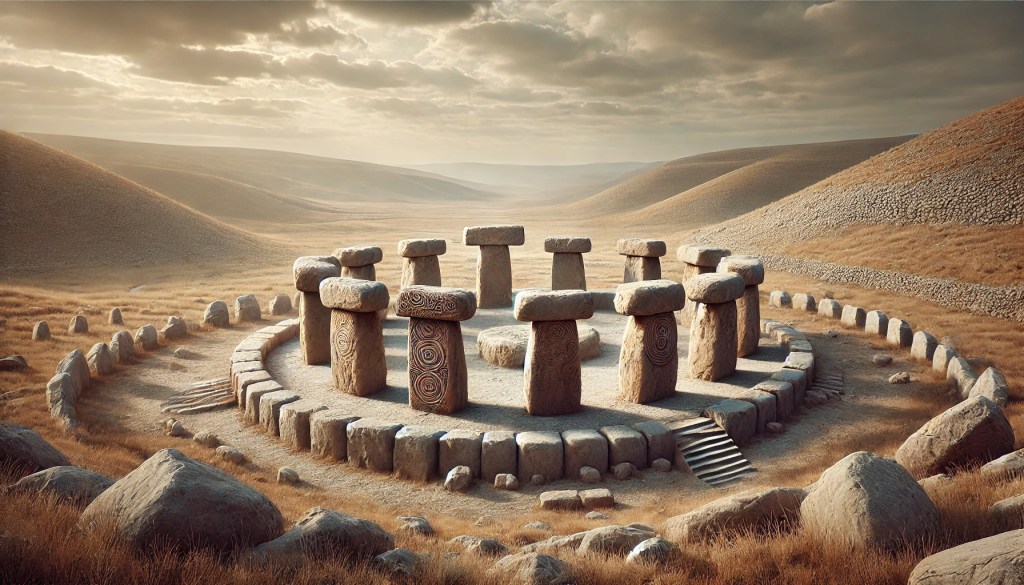
tell me about Gobekli Tepe?
Göbekli Tepe, located in southeastern Turkey, is one of the most significant archaeological discoveries in recent history. Dated to approximately 9600 BCE, it predates Stonehenge by about 6,000 years, making it one of the oldest known human-made religious structures.
Key Features of Göbekli Tepe:
- T-Shaped Pillars: The site is famous for its large, T-shaped stone pillars arranged in circular or oval enclosures. Some of these pillars are up to 5.5 meters tall and weigh as much as 10 tons. The carvings on these pillars depict a variety of animals such as lions, snakes, birds, and boars, and abstract symbols, suggesting symbolic or religious significance.
- Prehistoric Significance: Göbekli Tepe is believed to have been a ceremonial or religious center, possibly a temple. It was constructed by hunter-gatherer societies, challenging prior assumptions that large-scale, complex structures could only be built by settled agricultural societies. The site suggests that religious or social structures may have preceded the development of farming.
- Purpose and Meaning: The true purpose of Göbekli Tepe remains a subject of debate. Some researchers believe it was a place for religious rituals, while others suggest it may have been a gathering site for various nomadic groups. There is evidence of communal feasting, further hinting at its role as a social hub.
- Burial and Abandonment: Interestingly, Göbekli Tepe was intentionally buried after centuries of use. This burial preserved the site but has also raised questions about why its builders chose to cover it. Some theories suggest it was no longer needed as agricultural societies emerged, or that a shift in religious practices rendered it obsolete.
- Archaeological Importance: Discovered in the 1990s by German archaeologist Klaus Schmidt, Göbekli Tepe has reshaped our understanding of prehistoric humans and the transition from hunter-gatherer lifestyles to more settled communities. Excavations are ongoing, and it is believed that only a small portion of the site has been uncovered so far.
Göbekli Tepe’s significance lies in how it challenges existing theories about the rise of civilization and the relationship between religion, social structures, and the development of agriculture.
Who built Göbekli Tepe?
Göbekli Tepe was built by prehistoric hunter-gatherer societies, not by settled agricultural communities, which is what makes the site so groundbreaking. The builders lived during the Pre-Pottery Neolithic period, around 9600 BCE, long before the advent of metal tools, pottery, or even agriculture. This period was characterized by mobile or semi-nomadic groups that relied on hunting wild animals and foraging for food.
The construction of Göbekli Tepe challenges traditional assumptions about early human societies. Previously, it was believed that monumental architecture and complex social structures only developed after humans adopted farming and settled in permanent communities. However, the builders of Göbekli Tepe had not yet developed agriculture, yet they were able to organize large-scale labor and produce sophisticated stonework, suggesting that social and religious motivations may have been a driving force for the construction of such monumental structures.
Skills and Technology:
- Stone Tools: Despite lacking metal tools, the people of Göbekli Tepe were highly skilled stone workers. They used flint tools to carve the massive T-shaped pillars from local limestone quarries and create intricate animal reliefs and abstract symbols.
- Labor Organization: The scale of the construction, including the transport and erection of massive stone pillars, implies a high degree of social cooperation and possibly the presence of leadership or shared belief systems that motivated the builders.
Religious or Social Motivation:
It is likely that the people who built Göbekli Tepe were motivated by religious or spiritual beliefs, as the site appears to have been used as a ceremonial or ritual space. This suggests that religion or communal gatherings may have played a significant role in bringing people together to build these structures, even before the development of farming or settled life.
Transition to Agriculture:
Some archaeologists propose that the construction of Göbekli Tepe may have contributed to the eventual development of agriculture. As groups gathered for religious or social reasons, they may have needed to produce more food to support the growing community. This could have driven early experiments in plant and animal domestication in the surrounding region, known as the Fertile Crescent, where agriculture first emerged.
In summary, Göbekli Tepe was built by highly organized hunter-gatherers who likely used their religious or communal beliefs as a motivation to construct this massive site long before agriculture emerged.
Why was it buried?
The intentional burial of Göbekli Tepe is one of the most intriguing aspects of the site, and while the exact reasons remain unknown, several theories have been proposed by archaeologists and researchers.
Theories on Why Göbekli Tepe Was Buried:
- Cultural or Religious Transition: One leading theory is that Göbekli Tepe was deliberately buried because its purpose had become obsolete. As human societies transitioned from hunter-gatherer lifestyles to more settled agricultural communities, their spiritual beliefs, social structures, or ritual practices may have changed. The site might have lost its significance, and instead of abandoning it to the elements, they carefully buried it to honor its past importance.
- Preservation for Posterity: Another theory suggests that the people who used Göbekli Tepe buried it as an act of preservation. Covering the structures with soil may have been a way to protect the site, perhaps as a form of ritual closure, ensuring that the sanctity of the place remained intact even as it was no longer in active use. This act of preservation could have reflected deep respect for the site’s religious or communal significance.
- Symbolic Burial or Ritual Closure: The burial might have had symbolic importance. The act could have been part of a larger ritual, representing the “end” of a phase in their spiritual or social lives. Such ritual closures are common in many ancient cultures, where significant places or objects are intentionally decommissioned through specific ceremonies. In this case, burying Göbekli Tepe could have marked the end of its religious use or the beginning of a new social or spiritual order.
- Environmental or Practical Reasons: Some researchers have suggested that environmental changes might have played a role in the burial. Over time, the landscape around Göbekli Tepe might have become less favorable for large gatherings or rituals, such as changes in climate or available resources. If the site was no longer viable for its intended use, it might have been buried as a practical way to manage the changing environment or the demands of emerging agricultural societies.
- Change in Religious Beliefs: A shift in religious beliefs could also explain why Göbekli Tepe was buried. As agricultural societies developed, new forms of religious practice might have emerged that no longer required such large ceremonial spaces. The old structures might have been buried to make way for new forms of worship or social organization.
The Method of Burial:
The way Göbekli Tepe was buried is also significant. The site was filled with layers of soil, debris, and stone fragments, suggesting a deliberate and organized effort. This is not the result of a natural process like erosion or abandonment but appears to have been a planned and labor-intensive act. The care taken in burying the site supports the idea that it held great cultural or religious significance to the people who built and used it.
In summary, the burial of Göbekli Tepe likely reflects a complex mix of cultural, religious, or environmental changes. While the exact motivations remain uncertain, it is clear that the site was intentionally preserved or decommissioned as part of a significant societal shift.
Who discovered it?
Göbekli Tepe was first identified as an important archaeological site by Klaus Schmidt, a German archaeologist, in the mid-1990s. Although the site had been noted by other researchers before, Schmidt was the one who recognized its true significance and began detailed excavations.
Key Events in the Discovery:
- Initial Surveys in the 1960s: The site was initially discovered in 1963 by a joint survey team from Istanbul University and the University of Chicago. However, at the time, it was not recognized as a major archaeological find. The site was believed to be just an old Byzantine cemetery or a medieval hill due to the stone fragments scattered around.
- Klaus Schmidt’s Rediscovery in 1994:
- In 1994, Klaus Schmidt, who had been working in the region, revisited the area after reading a report from the original 1960s survey. Recognizing the significance of the T-shaped pillars and other features, Schmidt realized that Göbekli Tepe was much older and more important than previously thought.
- He began excavating the site under the auspices of the German Archaeological Institute and the Şanlıurfa Museum, and over the next two decades, his work revealed that Göbekli Tepe was likely the world’s oldest known monumental temple complex, dating back to around 9600 BCE.
Klaus Schmidt’s Contributions:
- Dating the Site: Schmidt’s excavations and analysis showed that Göbekli Tepe was constructed by Pre-Pottery Neolithic hunter-gatherers, challenging previous assumptions about early societies.
- Cultural Impact: He proposed that Göbekli Tepe was a religious or ceremonial site, built by these early human groups before the development of agriculture, which marked a fundamental shift in our understanding of human history.
- Ongoing Excavation: Schmidt worked at the site until his death in 2014, after which other archaeologists have continued his work. Today, only a portion of the site has been uncovered, with much more still hidden beneath the ground.
Klaus Schmidt’s rediscovery and excavation of Göbekli Tepe fundamentally altered our understanding of early human history and the origins of complex societies.
What did they worship?
The exact nature of the religious beliefs and practices at Göbekli Tepe remains speculative, as no written records or clear depictions of deities have been found. However, based on the site’s monumental architecture, carvings, and archaeological context, several theories suggest what the people who built and used Göbekli Tepe may have worshipped or believed in.
Theories About Religious Beliefs at Göbekli Tepe:
- Animal Veneration:
- The most striking feature of Göbekli Tepe is the carved images of animals on the large T-shaped stone pillars. These include dangerous creatures like lions, snakes, boars, scorpions, vultures, and various birds and reptiles. These animals might have held symbolic or spiritual significance, potentially representing protective spirits, totems, or supernatural forces.
- Some researchers believe that the people at Göbekli Tepe may have worshipped or revered these animals, possibly seeing them as intermediaries between humans and the spiritual world or as representations of deities or supernatural powers.
- Ancestor Worship:
- The T-shaped pillars are thought to represent stylized human figures. The central pillars in each enclosure are taller and more imposing than the others, possibly symbolizing important figures or deities. Some scholars suggest that these pillars could represent ancestors or mythical beings who were worshipped as part of the community’s religious practices.
- Ancestor worship might have been central to the spiritual life at Göbekli Tepe, with rituals performed to honor and communicate with the spirits of the dead, which was common in many early human societies.
- A Cult of Death and the Afterlife:
- Some of the carvings and symbols at Göbekli Tepe, such as vultures and headless human figures, have led to theories that the site may have been associated with death rituals or beliefs in an afterlife. In many ancient cultures, vultures were seen as symbols of death and rebirth because they scavenge dead bodies, “cleaning” them and allowing the soul to transition to another realm.
- There is also evidence of other Neolithic sites in the region where people practiced excarnation (the removal of flesh from bones, often involving birds like vultures). This suggests Göbekli Tepe could have been a place where rituals related to the dead or the afterlife were performed.
- Shamanistic Practices:
- Some researchers propose that the builders of Göbekli Tepe might have engaged in shamanistic practices. The elaborate carvings of animals and abstract symbols could represent visions experienced during altered states of consciousness, perhaps induced by rituals, dancing, or consuming psychoactive plants.
- Shamans, or spiritual leaders, might have played a role as intermediaries between the physical and spiritual worlds, using the site for rituals that facilitated contact with supernatural forces or ancestors.
- Sky and Cosmic Worship:
- Certain alignments at Göbekli Tepe, along with carvings of celestial symbols and animals, have led to speculation that the people of Göbekli Tepe might have had some form of sky or star worship. Some archaeologists suggest that the site could have been used for observing celestial events, and the positioning of some of the pillars might be aligned with astronomical phenomena, such as the movements of the sun or stars.
- The spiritual or religious system could have involved a connection between the earth, the heavens, and the afterlife, with Göbekli Tepe serving as a place where people gathered to connect with the cosmos.
Communal and Social Worship:
Göbekli Tepe’s construction suggests that it was not just a religious site but also a place for communal gatherings, where various groups of hunter-gatherers came together for rituals, feasts, and socializing. These events might have reinforced social bonds, while religious rituals centered around the beliefs in powerful animal spirits, ancestors, or other supernatural entities.
In conclusion, while we do not know the exact details of the belief system at Göbekli Tepe, the site was almost certainly a religious or ceremonial center. The worship may have revolved around animals, ancestors, death and the afterlife, shamanism, or the cosmos, with rituals performed to connect with supernatural forces or the spirits of the dead.
Any there any other similar sites?
Yes, there are several other prehistoric sites that share similarities with Göbekli Tepe, either in terms of their monumental architecture, ceremonial or ritual purposes, or their dating to the early Neolithic period. These sites, while not identical to Göbekli Tepe, provide valuable insights into early human societies and their religious or social practices. Here are some notable examples:
1. Karahan Tepe (Turkey)
- Location: Southeast Turkey, about 35 kilometers from Göbekli Tepe.
- Dating: Around 9500 BCE, contemporaneous with Göbekli Tepe.
- Key Features: Karahan Tepe is part of a larger complex of similar sites in the region known as the “T-shaped pillar” sites. It features large, T-shaped pillars similar to those found at Göbekli Tepe, as well as carved animals and symbols. Karahan Tepe is thought to have served a similar ceremonial or religious purpose, and ongoing excavations continue to reveal more about its significance.
- Importance: It suggests that Göbekli Tepe was not an isolated structure but part of a larger network of early ceremonial centers in the region.
2. Nevalı Çori (Turkey)
- Location: Southeast Turkey, near the Euphrates River.
- Dating: Around 8400 BCE.
- Key Features: Nevalı Çori is another early Neolithic site with T-shaped pillars and communal buildings. It features evidence of early domestication of plants and animals, as well as religious structures, including rectangular stone buildings with relief carvings and statues of human figures.
- Importance: Like Göbekli Tepe, Nevalı Çori demonstrates that early human societies were capable of creating monumental architecture before the widespread adoption of agriculture. However, Nevalı Çori is also significant for providing some of the earliest evidence of early farming.
3. Çatalhöyük (Turkey)
- Location: Central Turkey, near Konya.
- Dating: Around 7500 BCE to 5700 BCE.
- Key Features: Çatalhöyük is one of the largest and most well-preserved Neolithic settlements. Unlike Göbekli Tepe, it was a densely populated town, and its residents were already practicing agriculture. However, it shares similarities in terms of religious significance, with shrines and communal areas where rituals took place. Many homes had religious symbols, including animal heads, figurines, and paintings.
- Importance: While Çatalhöyük represents a later stage in human development, its emphasis on ritual spaces and the role of religion in daily life is a continuation of the religious traditions that likely began at sites like Göbekli Tepe.
4. Jerf el Ahmar (Syria)
- Location: Along the Euphrates River in northern Syria.
- Dating: Around 9500 BCE to 8700 BCE.
- Key Features: Jerf el Ahmar is an early Neolithic settlement featuring communal buildings, storage facilities, and circular subterranean structures, some of which are thought to have had ritual purposes. The site has evidence of early domestication and storage of grains, indicating a transitional phase from hunting and gathering to farming.
- Importance: Like Göbekli Tepe, Jerf el Ahmar shows that communal or ritual buildings were a feature of early Neolithic society. The use of communal space suggests a societal shift toward more complex social structures.
5. Ain Ghazal (Jordan)
- Location: Near modern-day Amman, Jordan.
- Dating: Around 7250 BCE to 5000 BCE.
- Key Features: Ain Ghazal is another large Neolithic settlement with a significant religious and ritual component. The site is famous for its plaster statues, which are some of the earliest large-scale human representations found in the region. These statues, often depicting human figures with large eyes and stylized bodies, are thought to have been used in rituals or ancestor worship.
- Importance: Ain Ghazal represents the later development of Neolithic religion and social complexity, with evidence of ceremonial structures and large-scale communal activities.
6. Khirokitia (Cyprus)
- Location: Southern Cyprus.
- Dating: Around 7000 BCE to 5000 BCE.
- Key Features: Khirokitia is one of the earliest Neolithic sites in the Mediterranean, known for its circular houses and complex settlement layout. The site includes evidence of ritual activity, such as burial practices where the dead were placed under the floors of houses, possibly reflecting ancestor veneration or beliefs in the afterlife.
- Importance: Khirokitia shows how early Neolithic societies across different regions developed complex social and ritual practices, often centered around communal spaces and symbolic activities.
7. Göbekli Tepe’s Neighboring Sites (Turkey)
- Other nearby sites, such as Sefer Tepe, Hamzan Tepe, and Gürcü Tepe, are part of the same region as Göbekli Tepe and share similarities in terms of architecture, ritual use, and T-shaped pillars. These sites are less excavated but are thought to have served similar ceremonial or religious functions, indicating that the region as a whole was a religious or ritual center during the Pre-Pottery Neolithic period.
Conclusion:
While Göbekli Tepe is unique in its scale and significance, other sites from the early Neolithic period share similar features, such as monumental architecture, animal carvings, communal spaces, and evidence of ritual practices. These sites, found across Turkey, Syria, Jordan, and Cyprus, suggest that early human societies were deeply engaged in religious and social activities long before the full development of agricultural life. Together, these sites help paint a picture of a complex and interconnected world of early religious and social systems.
What tools did they use?
The builders of Göbekli Tepe, who lived during the Pre-Pottery Neolithic period (around 9600 BCE), used stone tools to construct the monumental structures and create the intricate carvings found at the site. Since metal tools had not yet been invented, the people relied on a range of simple but effective tools made from materials available in their environment. Here’s an overview of the tools they likely used:
1. Flint Tools:
- Flint (a type of hard, sedimentary rock) was one of the primary materials used for tool-making at Göbekli Tepe. Flint tools were chipped and shaped into sharp edges that could be used for cutting, carving, and shaping stone. These tools were essential for:
- Carving the massive T-shaped pillars: Workers likely used flint chisels and blades to carve the intricate animal reliefs and symbols on the limestone pillars.
- Cutting and shaping the limestone blocks: Flint axes and chisels were probably used to quarry and shape the stone pillars before they were transported to the site.
- Bladelets and scrapers: Small flint bladelets and scrapers were used for more delicate work, such as refining carvings or processing materials used in construction or everyday life.
2. Obsidian Tools:
- Obsidian is a naturally occurring volcanic glass, which was also used for tool-making. It can be chipped to produce very sharp edges, making it useful for precision tasks. Though less common than flint, obsidian tools have been found at other Neolithic sites in the region, and it’s possible that Göbekli Tepe’s builders used it for fine carving and cutting tasks.
3. Limestone Tools:
- The builders may have also used tools made from softer stone, like limestone, which was readily available at the site. These tools could have been used for pounding, polishing, or shaping the large stone pillars.
- Hammerstones: These rounded stones, often made of harder material like quartzite, were likely used as hammers to strike chisels or directly break off pieces of limestone from the larger blocks.
4. Stone Hammers and Axes:
- Large stone hammers or axes made from hard stone like basalt or sandstone were likely used to quarry the limestone blocks for the pillars. These tools would have been essential for extracting large stone slabs from the quarries and rough-shaping them before final refinement.
- Percussive tools: Stones that were heavier and more durable than flint were likely used to help crack or split the large limestone slabs and create rough shapes for the pillars.
5. Wooden and Bone Tools:
- Wood and bone were likely used for handles and other implements. Wooden levers, sledges, and supports might have been employed to help transport the massive stone pillars from the quarry to the construction site.
- Bone tools, such as points or awls, could have been used for finer work or for tasks related to the preparation of materials used in construction or feasting at the site.
6. Quarrying and Transport Tools:
- The construction of Göbekli Tepe required not only tools for shaping the stone but also techniques for moving the large stones from nearby quarries to the site. Though no direct evidence of transport tools has been found, it’s likely that the builders used:
- Wooden sleds or rollers: Logs might have been placed under the massive stones to roll them to the site.
- Ropes: Made from plant fibers or animal hide, ropes could have been used to pull the stones over the rollers or onto sledges.
- Levers: Wooden levers might have been used to lift and position the stones once they reached the construction site.
7. Ritual and Symbolic Tools:
- Some of the carved images and symbols at Göbekli Tepe, such as the depictions of animals and abstract symbols, might have been created using specialized tools for religious or ceremonial purposes. These carvings were likely made with sharp flint or obsidian tools capable of creating detailed designs in the limestone.
Tool-Making Techniques:
- Knapping: The process of striking stone to produce sharp-edged tools, known as knapping, was a crucial skill. Flintknappers would hit a core of flint or obsidian with another stone (called a hammerstone) to remove sharp flakes, which could then be used as blades, scrapers, or chisels.
- Polishing and Grinding: Some tools, especially those used for more refined work, may have been polished or ground to smooth edges. For example, tools used for carving the intricate animal figures on the pillars might have required extra finishing to ensure precise, smooth cuts.
Conclusion:
The builders of Göbekli Tepe used a variety of simple but effective stone tools, primarily made from flint, obsidian, and other hard stones, to carve and construct the massive limestone structures. These tools and techniques, combined with a high degree of social organization and cooperation, allowed them to achieve monumental feats of construction long before the advent of metal tools or the wheel. The ingenuity and skill involved in the creation of Göbekli Tepe suggest that these early hunter-gatherer societies had advanced knowledge of stone working, tool-making, and communal labor.
rather than being stylised human figures could the t-shaped pillars have structural supports for a roof?
The idea that the T-shaped pillars at Göbekli Tepe could have served as structural supports for a roof has been considered, but the current consensus among archaeologists is that the pillars were more likely symbolic rather than purely functional. Here are a few reasons why they are typically interpreted as symbolic or ritualistic in nature, as well as the possibility that they could have also served structural purposes:
Evidence for Symbolic or Ritualistic Interpretation:
- Anthropomorphic Features:
- The T-shaped pillars are thought to represent stylized human figures because of certain carved features. Some of the pillars have arms, hands, and belts carved into them, suggesting that they symbolize human or supernatural beings rather than serving as purely structural elements.
- This anthropomorphic aspect aligns with the idea that Göbekli Tepe was a religious or ceremonial site, where these pillars might have represented ancestors, gods, or mythical figures.
- Positioning and Layout:
- The arrangement of the pillars in circular or oval enclosures suggests a ritualistic or ceremonial function. In the center of each enclosure, two larger pillars are placed, and these are often interpreted as central, possibly symbolic figures, while the other pillars form a ring around them. This layout doesn’t necessarily suggest a need for a roof, but rather the creation of an open, sacred space for communal or religious activities.
- The open layout is also seen as conducive to outdoor gatherings and rituals, where visibility of the central pillars and the carved symbols would have been important.
- Lack of Roof Evidence:
- No definitive evidence of roofing materials has been found at Göbekli Tepe, such as postholes or other indicators that a permanent roof structure once covered the site. If the enclosures were meant to have roofs, we would expect to find evidence of additional supports or beams, but such remains are lacking.
Could the Pillars Have Had a Dual Purpose as Structural Supports?
While the pillars are generally interpreted as symbolic, it’s possible they could have served dual purposes, both symbolic and structural:
- Temporary or Light Roofs:
- Some researchers suggest that the pillars could have supported light, temporary coverings made of organic materials like wood or animal hides. These roofs could have provided shade or shelter during rituals, but because organic materials decay over time, no physical evidence of such roofs would remain.
- In this scenario, the T-shaped pillars would have had both symbolic importance and a practical function in supporting light coverings for temporary events or ceremonies.
- Partial Covering:
- Another possibility is that some of the enclosures could have been partially covered, with the central area open to the sky and the outer areas shaded by a roof supported by the pillars. This would have allowed participants to view the central symbolic figures (the two largest pillars) while being sheltered around the periphery.
- Windbreaks or Screens:
- Instead of full roofs, the pillars could have supported windbreaks or screens made of wood, reeds, or animal skins, used to create a more protected, enclosed space. These screens could have been functional in shielding participants from the elements while still maintaining the ritualistic atmosphere of an open-air site.
- Hybrid Interpretation:
- It’s possible that the pillars were designed to be multifunctional, combining structural and symbolic roles. The T-shape could have been a practical design for stability, while the carvings and positioning indicate their symbolic importance in religious or communal activities. This hybrid role might reflect how early human societies often merged practicality with spiritual meaning.
Conclusion:
Although the primary interpretation of the T-shaped pillars at Göbekli Tepe is that they were symbolic, representing humans or supernatural figures, the idea that they could have also served as structural supports for light or temporary coverings is not entirely ruled out. The lack of direct evidence of roofs, combined with the anthropomorphic features and ceremonial layout, suggests that if the pillars had a structural role, it was likely secondary to their religious or symbolic function.
Göbekli Tepe may have been an open-air sanctuary or ceremonial space, but the potential for temporary or partial coverings supported by the pillars remains a possibility that aligns with both practical needs and ritualistic significance.
are there any alternative theories about gobekli type?
Yes, there are several alternative theories about the purpose and significance of Göbekli Tepe, some of which challenge or expand on the mainstream view that it was a purely religious or ceremonial site. These alternative theories suggest other roles for the site, or offer different interpretations of its construction and use. Here are some of the most notable ones:
1. Astronomical Observatory or Cosmic Alignment Theory:
- Theory: Some researchers, including astrophysicists and archaeoastronomers, have proposed that Göbekli Tepe may have been used as an astronomical observatory or had alignments with celestial bodies. The arrangement of the pillars could have been designed to track stars, solstices, or other celestial events.
- Evidence: Some studies claim that certain pillars are aligned with particular stars or constellations, such as Sirius, and that the layout of the site might have had cosmic significance. The carvings of animals on the pillars are thought to represent constellations or celestial events.
- Criticism: This theory is debated, with critics pointing out that there’s no conclusive evidence that the builders of Göbekli Tepe had the advanced astronomical knowledge necessary to design such alignments. Additionally, much of the evidence is speculative and difficult to prove without written records.
2. Feasting and Social Gathering Site:
- Theory: Some archaeologists propose that Göbekli Tepe was not solely a religious site but also a place where large feasts and communal gatherings were held. The site could have been a center for social interaction, where different groups of hunter-gatherers met, shared food, and strengthened social bonds.
- Evidence: Archaeological findings at the site, such as large amounts of animal bones and evidence of food preparation, suggest that communal feasting was a significant activity. The preparation of food and drink, especially involving large quantities of meat, would have been a way to build social cohesion among early human groups.
- Criticism: While feasting might have taken place, critics argue that this does not explain the monumental architecture and the elaborate carvings, which suggest a deeper religious or ceremonial purpose beyond just social gatherings.
3. Center for Trade and Exchange:
- Theory: Another theory suggests that Göbekli Tepe was a hub for trade and exchange between different groups of people. As a central meeting point, it could have facilitated the exchange of goods, ideas, and cultural practices between various hunter-gatherer groups in the region.
- Evidence: Some archaeologists point to the location of Göbekli Tepe, which is near the intersection of different environmental zones, as evidence that it may have been a place where various groups came together. The production of stone tools and the possibility of exchanging food resources also support this idea.
- Criticism: Although trade could have been a secondary function of the site, the sheer scale and effort involved in building the site suggest that its primary purpose was more symbolic or spiritual, rather than purely economic.
4. A Fertility or Earth Mother Cult Site:
- Theory: Some scholars have proposed that Göbekli Tepe could have been the center of a fertility or Earth Mother cult. The animal carvings and the circular enclosures are thought to symbolize cycles of life, death, and rebirth, possibly connected to fertility rituals or beliefs in the earth’s regenerative powers.
- Evidence: The prominence of animal carvings and the association of circular spaces with life cycles in other Neolithic cultures have led some to believe that Göbekli Tepe may have played a role in fertility rituals. Some argue that the circular enclosures resemble womb-like structures, which could be linked to ideas of rebirth and fertility.
- Criticism: This theory is largely speculative and lacks concrete evidence. The animal motifs could have other symbolic meanings, and there is no direct link between Göbekli Tepe and known fertility cults from later periods.
5. A Site of Pilgrimage:
- Theory: Another suggestion is that Göbekli Tepe served as a pilgrimage site for distant groups of people who traveled to it for religious or ceremonial reasons. It may have been a sacred site where large gatherings took place during special times of the year, such as solstices or equinoxes.
- Evidence: The size of the site and the effort required to build it suggest that it was a place of great importance, possibly attracting groups from a wide area. The central pillars in the enclosures could represent deities or spirits that people came to honor or commune with.
- Criticism: Although this theory helps explain the scale and significance of the site, it doesn’t address why Göbekli Tepe was abandoned and buried, nor why there are no clear paths or evidence of pilgrimage routes leading to the site.
6. Early Agricultural Rituals and the Transition to Farming:
- Theory: Some archaeologists have proposed that Göbekli Tepe might have played a key role in the transition from hunting and gathering to agriculture. The rituals performed at the site could have been linked to early agricultural practices or the cultivation of plants.
- Evidence: The region around Göbekli Tepe is part of the Fertile Crescent, where the domestication of plants and animals first took place. The construction of such a large, communal site might have encouraged people to stay in one place longer, leading to experiments with plant cultivation.
- Criticism: This theory lacks direct evidence that Göbekli Tepe was used for agricultural rituals or that the builders were involved in early farming. The site seems more closely associated with hunter-gatherer societies than with settled agricultural communities.
7. Göbekli Tepe as a “School” for Stone Carvers:
- Theory: A more recent theory suggests that Göbekli Tepe might have been a training ground for stone carvers. The craftsmanship evident in the carved pillars suggests advanced knowledge of stonework, which could have been passed down from generation to generation.
- Evidence: The complexity and sophistication of the carvings at Göbekli Tepe are impressive for a time when metal tools were not yet available. The site might have been a place where skilled artisans were trained in the art of stone carving, which could have had spiritual or symbolic significance.
- Criticism: While this theory explains the skill level of the stone carvers, it doesn’t fully account for the religious or symbolic aspects of the site. It’s more likely that the stoneworking was tied to the religious or ceremonial function of the site, rather than a separate craft school.
Conclusion:
There are several alternative theories about Göbekli Tepe, ranging from its potential use as an astronomical observatory to a center for social gathering, trade, or fertility rituals. While most of the evidence supports the idea that it was primarily a religious or ceremonial site, these alternative theories reflect the complexity of interpreting such an ancient and enigmatic site. Since much of Göbekli Tepe remains un-excavated, future discoveries may provide further insights into its true purpose and significance.





 Conversations with AI
Leave a comment