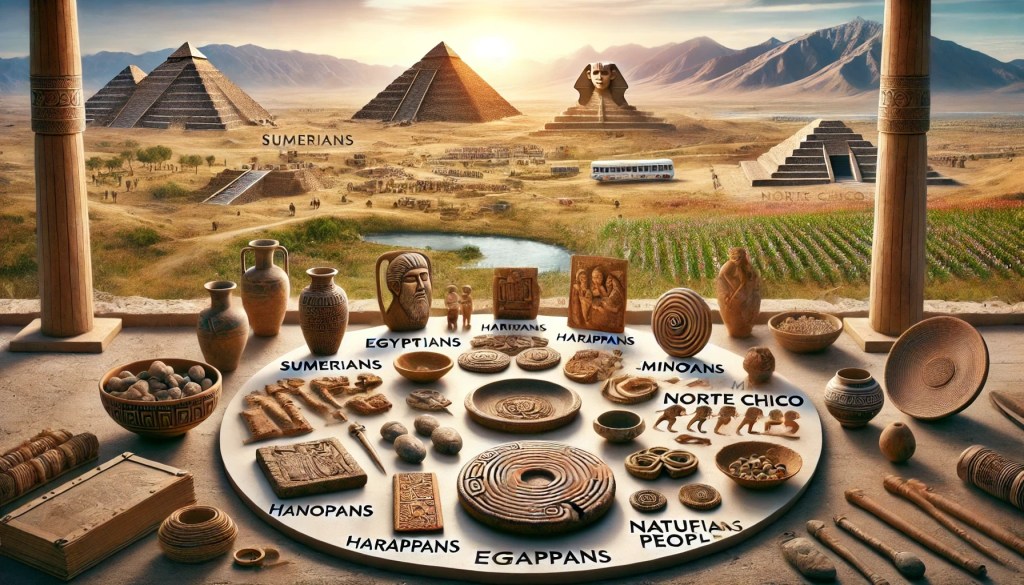
Question: list the earliest people, then as individual chapters elaborate on each culture listing their key accomplishments and expand each point. finally conclude with a chapter on whether there could have been any shared knowledge between the cultures.
Earliest Peoples
- Sumerians
- Ancient Egyptians
- Harappans (Indus Valley Civilization)
- Shang Chinese
- Minoans
- Norte Chico Peoples
- Naufians
Chapter 1: Sumerians
Key Accomplishments:
- Cuneiform Writing:
- Developed one of the world’s first writing systems around 3500 BCE.
- Used for recording transactions, legal documents, literature, and administrative records.
- Enabled the creation of extensive historical records.
- Ziggurats:
- Massive step pyramids serving as temples and administrative centers.
- Examples include the Great Ziggurat of Ur.
- Symbolized the religious and political power of the priestly class.
- The Wheel:
- Invented around 3500 BCE, initially for pottery.
- Revolutionized transport and agriculture by enabling the creation of carts and chariots.
- City-States:
- Urban centers like Ur, Uruk, and Eridu.
- Each city-state had its own ruler and patron deity.
- Developed early forms of government and social organization.
- Mathematics and Astronomy:
- Base 60 number system still used in measuring time and angles.
- Created lunar calendars and made significant astronomical observations.
- Legal Codes:
- The Code of Ur-Nammu, one of the earliest known law codes.
- Laid foundations for later legal systems, such as the Code of Hammurabi.
Chapter 2: Ancient Egyptians
Key Accomplishments:
- Hieroglyphics:
- Complex system of pictorial writing used for religious texts, monumental inscriptions, and administrative documents.
- Key texts include the Book of the Dead and various temple inscriptions.
- Pyramids:
- Monumental tombs for pharaohs, with the Great Pyramid of Giza being the most famous.
- Showcased advanced engineering and understanding of mathematics.
- Advances in Medicine:
- Early medical texts like the Edwin Smith Papyrus.
- Practices included surgery, dentistry, and an understanding of various ailments.
- Calendar System:
- Developed a solar calendar with 365 days, later influencing the Julian and Gregorian calendars.
- Essential for agricultural planning and religious festivals.
- Art and Sculpture:
- Highly stylized art emphasizing order and continuity.
- Created iconic statues, reliefs, and paintings depicting deities, pharaohs, and everyday life.
- Engineering and Architecture:
- Constructed monumental temples, obelisks, and intricate irrigation systems.
- Innovations included the use of the arch and the mastery of stone cutting.
Chapter 3: Harappans (Indus Valley Civilization)
Key Accomplishments:
- Urban Planning:
- Cities like Mohenjo-Daro and Harappa featured grid layouts.
- Advanced drainage systems and standardized building materials.
- Script:
- Developed an undeciphered writing system used on seals, pottery, and other artifacts.
- Possibly used for administrative and trade purposes.
- Trade Networks:
- Extensive trade with Mesopotamia, Central Asia, and possibly Egypt.
- Exchanged goods like cotton textiles, pottery, and semi-precious stones.
- Standardized Weights and Measures:
- Used uniform weights for trade and construction, indicating a high degree of economic regulation.
- Advanced Metallurgy:
- Produced copper, bronze, lead, and tin artifacts.
- Metallurgical skills evidenced by tools, weapons, and decorative items.
- Public Baths:
- The Great Bath of Mohenjo-Daro, indicating an emphasis on cleanliness and ritual purification.
Chapter 4: Shang Chinese
Key Accomplishments:
- Oracle Bones:
- Earliest known form of Chinese writing used for divination.
- Provided insights into the political, social, and religious life of the Shang Dynasty.
- Bronze Casting:
- Mastered techniques for casting bronze vessels and weapons.
- Bronze artifacts were used in rituals and as symbols of power.
- Urban Centers:
- Fortified cities with palaces, temples, and elaborate tombs.
- Archaeological sites like Anyang reveal complex social structures.
- Agricultural Innovations:
- Introduction of wet-rice cultivation and advanced farming tools.
- Supported a growing population and urbanization.
- Military Technology:
- Utilized chariots and bronze weapons, enhancing their military capabilities.
- Development of organized armies and defensive strategies.
- Silk Production:
- Early evidence of sericulture (silk farming) and weaving.
- Silk became a valuable trade commodity.
Chapter 5: Minoans
Key Accomplishments:
- Palatial Architecture:
- Complex structures like the Palace of Knossos, featuring advanced construction techniques.
- Included administrative, religious, and residential areas.
- Linear A Script:
- Undeciphered writing system used for administrative purposes.
- Found on clay tablets, pottery, and other artifacts.
- Advanced Art:
- Frescoes, pottery, and jewelry with intricate designs depicting religious ceremonies, nature, and daily life.
- Notable for their vibrant colors and dynamic compositions.
- Maritime Trade:
- Extensive trade network across the Aegean Sea and Mediterranean.
- Exported goods like pottery, olive oil, and textiles.
- Religious Practices:
- Worship of nature deities, ritualistic ceremonies, and possibly bull-leaping rituals.
- Evidence from frescoes, statues, and sanctuaries.
- Engineering and Urban Planning:
- Complex water management systems, including aqueducts and drainage.
- Well-planned urban centers with multi-story buildings.
Chapter 6: Norte Chico Peoples
Key Accomplishments:
- Monumental Architecture:
- Large ceremonial platforms and mounds, such as those at Caral.
- Indicate complex social organization and religious practices.
- Quipu:
- Early form of record-keeping using knotted strings.
- Possibly used for administrative and accounting purposes.
- Agriculture:
- Cultivation of cotton, beans, squash, and other crops.
- Enabled the development of sedentary communities.
- Fishing and Maritime Skills:
- Reliance on maritime resources, including fish and shellfish.
- Developed advanced fishing techniques and possibly early boat construction.
- Textile Production:
- Advanced weaving techniques producing fine cotton textiles.
- Textiles were an important trade commodity.
- Urban Centers:
- Settlements like Caral, with evidence of urban planning and social stratification.
- Included residential areas, ceremonial sites, and administrative buildings.
Chapter 7: Shared Knowledge Between Cultures
Potential Shared Knowledge:
- Writing Systems:
- While the scripts varied greatly, the concept of recording information was widespread.
- Possible indirect influence through trade and cultural exchanges.
- Architectural Techniques:
- Use of monumental architecture and urban planning.
- Exchange of ideas through trade networks and migrating artisans.
- Agricultural Practices:
- Irrigation and crop cultivation techniques.
- Spread of agricultural knowledge through trade and migration.
- Trade Networks:
- Extensive trade facilitated the exchange of goods, technologies, and ideas.
- Cultural diffusion occurred along trade routes connecting these early civilizations.
- Mathematics and Astronomy:
- Development of calendars and mathematical systems.
- Shared astronomical knowledge possibly transmitted through observation and communication.
- Legal and Social Structures:
- Emergence of governance systems and legal codes.
- Similarities in social organization and administrative practices suggest potential knowledge exchange.
Chapter 7: The Natufians
Key Accomplishments:
- Settlement Patterns:
- One of the first cultures to establish permanent settlements around 12,500 to 9,500 BCE.
- Sites like Jericho and Ain Mallaha are examples of early sedentary villages.
- Agriculture and Domestication:
- Transitioned from foraging to cultivating wild cereals like wheat and barley.
- Evidence of early domestication of animals, particularly dogs.
- Architecture:
- Built circular, semi-subterranean houses with stone foundations.
- Some sites show evidence of communal buildings and storage facilities.
- Tool Innovation:
- Created microlithic tools and composite sickles for harvesting cereals.
- Developed ground stone tools, such as mortars and pestles, for processing food.
- Social Organization:
- Burial practices suggest complex social structures and belief systems.
- Evidence of communal rituals and possibly early forms of social stratification.
- Art and Symbolism:
- Produced personal ornaments, such as beads and pendants, indicating a sense of individual and group identity.
- Engraved stones and bones with geometric patterns and animal motifs.
Conclusion
The early peoples of Sumer, Egypt, the Indus Valley, Shang China, Crete, Norte Chico and Natufians each made unique contributions to human civilization. While their developments were independent, there is evidence of shared knowledge and indirect influence through trade and migration. The exchange of ideas in writing, architecture, agriculture, and governance laid the groundwork for future advancements and the interconnected world we see today.





 Conversations with AI
Leave a comment