*2 posts in a week! I was in hospital and this came to mind.
**this might not be everyones cup of tea, could be controversial, I can’t make any apologies.
The Epicurean Dilemma & The Random Wave
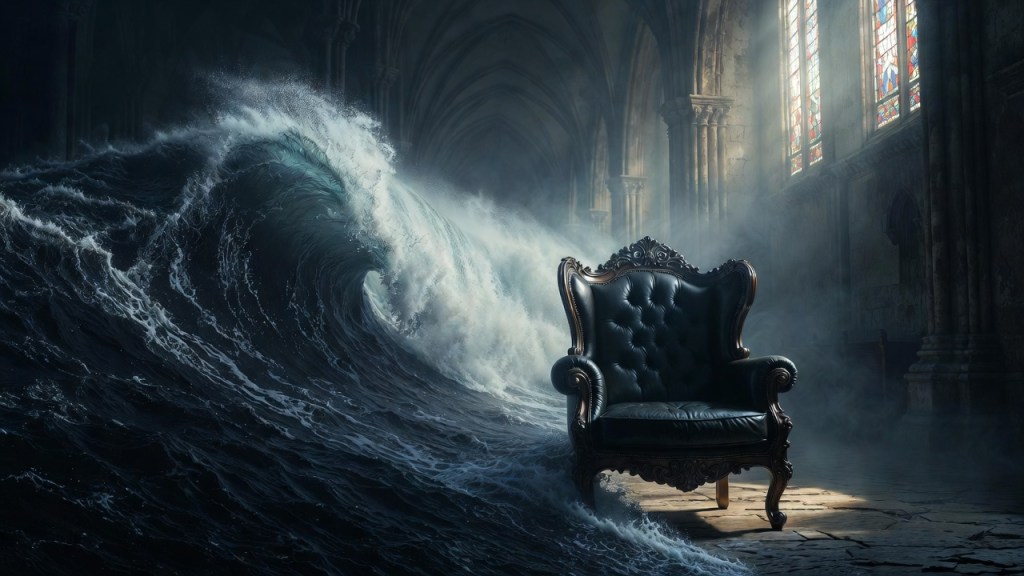
Imagine, for a moment, the sheer, indifferent mathematics of a tectonic shift. Deep beneath the ocean’s surface, a fault line that has been quietly gathering tension for centuries finally snaps. It is a monumental release of kinetic energy, entirely devoid of malice, intent, or divine retribution. This energy transfers into the water, silently travelling across the open sea. When it finally meets the shallow continental shelf, it rears up into a towering wall of grey water and indiscriminately erases the coastline.
In its wake, it leaves a perfectly random tapestry of survival and destruction. One house is swept out to the cold abyss, whilst the house directly next door remains entirely untouched, the morning paper still sitting dry on the porch. The devout believer who spent their entire life in pious submission shares the exact same muddy, tragic fate as the steadfast atheist. The wave does not check the local parish registry before it breaks. It simply obeys the laws of physics.
Now, juxtapose this raw, terrifying display of natural reality with a serene Sunday morning in a suburban congregation. Here, under vaulted ceilings, people are softly singing hymns, bowing their heads in gratitude to an all-knowing, all-loving “Overlord”—a supreme architect who, according to the brochure, designed the very tectonic plates that just fractured a continent away.
The cognitive dissonance required to hold both of these realities in one’s head is staggering.
This glaring contradiction is the beating heart of the Epicurean Paradox, a philosophical problem of evil that has haunted theologians for millennia. The Greek philosopher Epicurus laid the trap beautifully: If God is willing to prevent evil, but is not able, then he is not omnipotent. If he is able, but not willing, then he is malevolent. If he is both able and willing, then whence cometh evil? And if he is neither able nor willing, then why call him God?
When confronted with the indiscriminate devastation of a tsunami, the standard theological defences begin to look incredibly fragile. The usual apologetic shield of “human free will” shatters entirely; a tsunami is not a choice made by a sinful human. It is a feature of the system’s design. If an Overlord built a world where innocent suffering is baked into the very physics of the earth, it forces a bleak realisation: the creator of the universe is either entirely ambivalent to our existence, or possesses a morality so deeply warped that we could never hope to understand it.
To live an eternity with a being that would orchestrate such a dreadful system seems less like paradise and more like a hostage situation. Yet, despite this glaring reality, the pews remain full. The system holds. The question for any inquisitive mind is: how?
The Empty Chair and the Protection Racket
To understand how this grand illusion sustains itself in the face of such overwhelming evidence—how sane people can look at the random devastation of a tsunami and still praise a divine architect—we must look at religion not as a spiritual truth, but as a control masterpiece. It is, quite simply, the most enduring and masterfully crafted psychological protection racket in human history.
Consider the mechanics of a classic mafia shakedown. The enforcer walks into your establishment, casts an eye around, and says, “Nice little eternal soul you have here. It would be a dreadful shame if it were to end up burning in a lake of fire for all eternity.” The threat is firmly established, and the terms of protection are non-negotiable. You must pay your dues—in obedience, in tithes, in unwavering loyalty—or face the consequences. It is a rigged game where the “protection” you are paying for is from the very entity threatening you in the first place.
But here is the truly magnificent, deeply cynical twist of the whole operation: the Don isn’t even in the building.
If you were to kick open the door to the back room to confront this Ambivalent Overlord, you would find nothing but an empty leather chair. The mob boss simply is not there. The entire racket is being run by the minions. It is the earthly clerics, the institutions, and the self-appointed gatekeepers who collect the dues and dole out the fear in the name of a phantom.
And what a spectacularly effective fear it is. When your neck is constantly on the proverbial block, you become incredibly malleable. This system brilliantly immunises itself against critical thinkers by making the very act of questioning a punishable offence. If the Overlord is all-knowing, he knows you are merely thinking about doubting him. Doubt is labelled a ‘sin’, a spiritual failing, a test of faith. It is a closed-loop security protocol designed to paralyse the intellect. After all, if the penalty for a logical query is a dreadful eternity, the safest bet is simply to nod along, praise the empty chair, and keep your head down.
This brings us to the fascinating psychology of the “Big Lie.” Is religion the biggest lie? One could certainly argue it is the most successfully sustained one. We often assume that critical thinkers are winning, that people would easily see through a colossal fabrication. Yet, historically and psychologically, the exact opposite is true. The bigger the lie, the more readily it is swallowed.
A small lie invites scrutiny; a lie so audacious, so unimaginably vast that it is woven into the very fabric of our architecture, our language, and our laws, bypasses critical thought entirely. People assume it simply must be true, because surely no one would dare invent something of that magnitude? To question the Big Lie is not just to question a book; it is to question the bedrock of your family, your community, and your entire reality. It is much warmer and safer inside the protection racket than it is standing out in the cold, staring at an empty chair.
The Great Disrupter to His Noodly Appendage
For centuries, the minions running the protection racket had a wonderfully foolproof method for keeping the masses entirely malleable: they held the only set of keys to the library. When the ‘honest to goodness’ word of the Overlord is locked away in a language the commoners cannot read, monopolising the truth is child’s play. The clerics could dictate the terms and conditions of salvation, and the peasants had no choice but to take their word for it.
Then came the printing press—the original, and perhaps the greatest, Great Disrupter in human history.
When Johannes Gutenberg’s marvellous contraption clattered into existence, it did not merely print Bibles; it democratised knowledge. Suddenly, the sacred texts were translated into the common tongue and distributed far beyond the heavily guarded walls of the monasteries. For the first time, everyday people could read the rules of the racket for themselves. And when they did, they began to notice the structural cracks. They spotted the glaring contradictions, the bizarre ancient laws, and the rather convenient financial demands of the clergy.
The printing press allowed humanity to realise that the booming voice of the Overlord was often just the ink and ego of powerful men. It was the first time the curtain was pulled back to reveal the empty chair. The spell started to break, and enlightenment began to seep through the cracks.
However, arguing logic with an institution that relies on an unfalsifiable ‘Big Lie’ is a famously exhausting endeavour. Apologetics—the theological art of performing complex mental gymnastics to justify the unjustifiable—can twist any logical challenge into a matter of “divine mystery” or “faith”. When logic fails to penetrate the armour of a closed-loop system, one must reach for a far sharper weapon: pure, unadulterated absurdity.
Enter the magnificent, carbohydrate-rich glory of the Flying Spaghetti Monster.
Pastafarianism is not merely a modern internet joke; it is a profound philosophical tool, perfectly engineered to expose the absurdity of the protection racket. It uses the exact same ‘logic’ as organised religion to demonstrate how utterly ridiculous unfalsifiable claims truly are. If a cleric demands you prove that their invisible, ambivalent Overlord does not exist, you can simply demand they prove that a giant, invisible ball of spaghetti does not exist. The burden of proof is delightfully, identically zero.
Why is our noodly friend such a potent threat to a millennia-old institution? Because whilst dogma is almost entirely immune to logic, it is deeply, fundamentally allergic to being laughed at.
You cannot maintain a terrifying mafia shakedown if the victim is giggling at the enforcer’s outfit. The moment you introduce satire to the equation, the psychological chains of the racket dissolve. You cannot be reprogrammed or kept in line by fear if you are pointing out the sheer ridiculousness of the programming itself. Laughing at the Overlord breaks the spell far more effectively than debating him. It turns the terrifying prospect of a ‘dreadful eternity’ into a choice: do you want the comforting, coercive lie of the mob boss, or the bleak, honest, and hilariously absurd freedom of the Pasta?
The Modern Upgrade: Algorithms and the God Void
One might reasonably assume that in an era where the sum total of human knowledge sits illuminated in our pockets, the protection racket would finally collapse. With access to every scientific journal, historical critique, and satirical essay at the swipe of a finger, why hasn’t humanity collectively handed the Overlord his notice? Why does the biggest lie sustain itself so stubbornly today?
The answer lies in a deeply uncomfortable truth about human psychology: the sheer, existential terror of the “God void.”
If you successfully dismantle the protection racket, kick down the door to the back room, and finally prove to yourself that the Don’s chair is entirely empty, you are not immediately met with a parade of intellectual victory. You are met with a deafening, cosmic silence. Stripping away the “Big Lie” means facing the stark reality of an utterly indifferent universe. It means accepting that there is no grand script, no ultimate safety net, and no divine parent figure watching over us. For many, that empty space is far more terrifying than the threat of hellfire.
To avoid looking into that terrifying void, humanity has simply upgraded the “glorious perfect religious circle” for the digital age. We haven’t dismantled the racket; we have merely digitised it.
Yesterday’s physical pulpit has been seamlessly swapped for today’s algorithmic echo chamber. The modern believer—or indeed, the modern zealot of any rigid ideology—no longer needs a cleric to keep them in line. The algorithm does the heavy lifting, serving up a cosy, endless stream of validation that ensures they never have to face the quiet, empty space of independent thought. The algorithm is the new enforcer, and it is brutally effective.
The fear that keeps the masses malleable has also evolved. Whilst the literal fear of a cosmic mob boss and his lake of fire still lingers in some quarters, it has largely been replaced by a much more immediate, sociological terror: the fear of the digital excommunication. To step outside the algorithmic bubble, to question the modern dogma of your chosen tribe, is to risk being “cancelled.” It is the threat of social death.
If you don’t agree with the bubble, you lose your community, your identity, and your tribe. The “neck on the block” feeling remains entirely intact. We have traded the priest for the influencer, and the threat of eternal damnation for the threat of being permanently ostracised. The minions are still running the show, they just operate out of Silicon Valley now, dealing in metrics and engagement rather than tithes and prayers. The racket sustains itself because the cost of intellectual freedom—the cost of stepping into that cold, bleak void—is simply deemed too high a price to pay.
Sagan’s Demons and the Bleak Reality
When we finally drag the protection racket into the light, expose the empty chair, and step outside the algorithmic echo chamber, we are left standing on the precipice of that terrifying God void. The great danger now is our innate, desperate desire to fill that gaping hole with something—anything—else.
If we simply dismantle the old religious architecture without simultaneously championing critical thought, human nature dictates that we will inevitably invent new phantoms to fear. The brilliant astrophysicist Carl Sagan warned us of precisely this in his prophetic book, The Demon-Haunted World. He cautioned that if we lose our grip on scientific rigour and rational skepticism, we will slide right back into the darkness, clutching at pseudosciences, conspiracy theories, and pure, unadulterated belief. We will simply swap out the Ambivalent Overlord for a new, equally absurd set of demons.
We must remember the most chilling aspect of the racket: the mob boss was never actually there. The Don’s chair has always been empty. It is the minions we must watch out for. And those minions are remarkably adaptable. If they can no longer sell you salvation in a church, they will sell you absolute certainty in a digital forum, a political extreme, or a wellness cult. They will rebrand the Big Lie, demanding your absolute submission and your financial tithes, all whilst threatening you with a modernised version of hell if you dare to step out of line. The megaphone merely changes hands; the desire to control the malleable masses remains exactly the same.
So, how do we break the cycle permanently? How do we survive the bleak reality of an indifferent universe without falling prey to the next protection racket?
We must embrace the bleakness. We must find the profound, beautiful liberation in the fact that there is no grand script.
If we accept that morality is not a cosmic law handed down under the threat of torture, but rather a biological and sociological invention forged by human empathy, our actions instantly become infinitely more valuable. We do not need an eye in the sky or a hashtag to tell us to be kind. We can rely on ‘Biological Morality’—the basic, universal primate instinct to reduce suffering in our tribe. A hungry person feels hunger the exact same way, regardless of which philosophical bubble they reside in. Empathy that does not require the promise of heaven or the threat of hell is the only thing in this world that isn’t fabricated.
The moment you stop fearing the dreadful eternity promised by the minions, the Overlord simply ceases to exist. He becomes nothing more than a historical fiction, a shadow cast by an empty chair. Yes, stepping out of the glorious, perfect religious circle leaves us in the cold, bleak open air. But for the first time in human history, we are breathing freely. We are finally being good for goodness’ sake, entirely unbothered by the silence of the void.



 Conversations with AI
Leave a comment