*Not even mentioning potential political reasons.
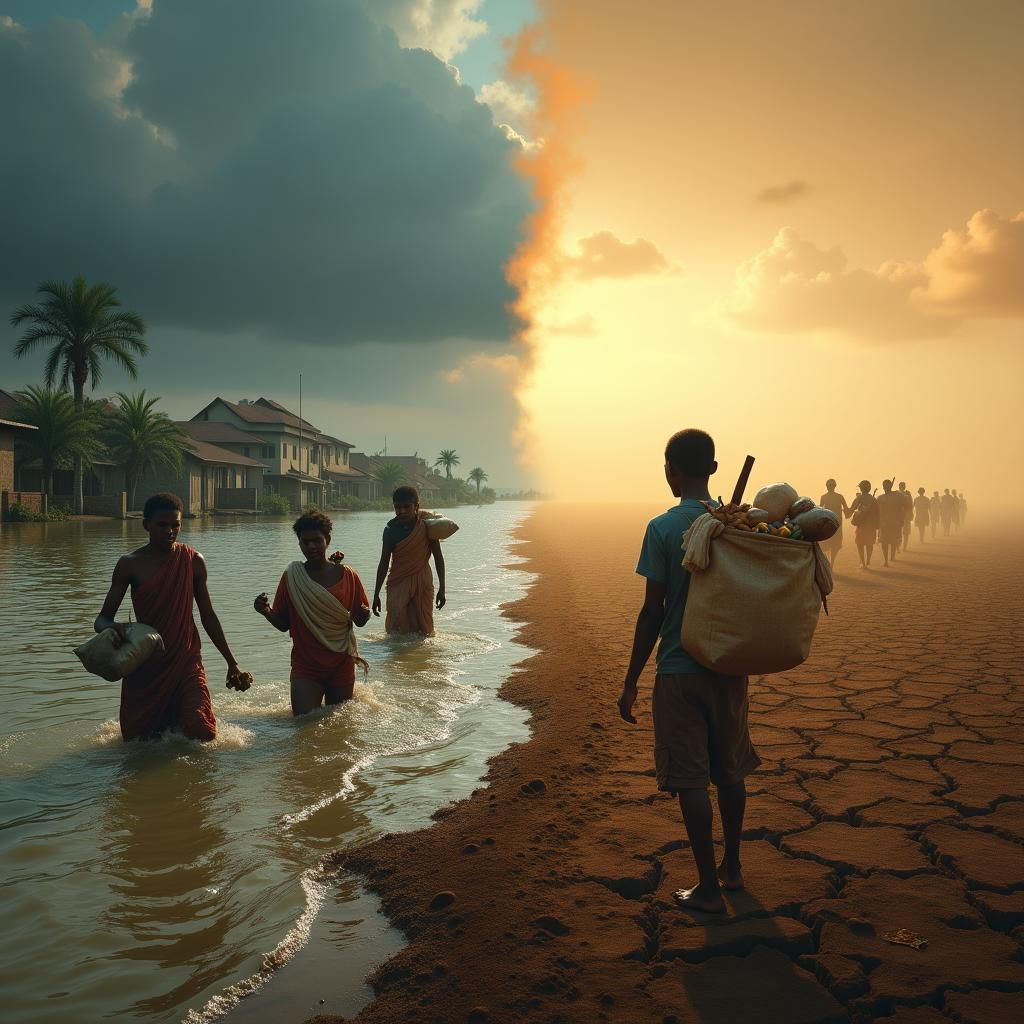
Imagine a family in Bangladesh, packing their few belongings into a rickety boat as floodwaters swallow their home. Or a farmer in sub-Saharan Africa, watching crops wither under an unrelenting sun, knowing survival means leaving everything behind. These are not scenes from a dystopian novel—they are unfolding realities for millions of people worldwide. Climate change, once discussed as a distant threat, is now reshaping human lives in profound and irreversible ways, forcing migration on a scale never before seen.
This article explores how rising temperatures, extreme weather events, and environmental degradation are driving human movement. It’s a story of survival, inequality, and adaptation—one that matters deeply to younger generations who will inherit a planet transformed. By understanding these dynamics, we can better grasp the challenges ahead and the urgent need for solutions.
Human migration linked to environmental changes isn’t entirely new. Historical records show that droughts, floods, and resource scarcity have displaced communities for centuries. The Dust Bowl of the 1930s in the United States, for instance, pushed over 2.5 million people to abandon the Great Plains after severe soil erosion and dust storms made farming impossible [1]. What’s different today is the speed, scale, and interconnectedness of climate-driven migration. Since the Industrial Revolution, human activities have released unprecedented levels of greenhouse gases, accelerating global warming. The Earth’s average temperature has risen by approximately 1.1°C since the late 19th century, with the last decade (2011–2020) being the warmest on record [2].
This warming has triggered cascading effects: melting ice caps, rising sea levels, and more frequent extreme weather events. Low-lying island nations like Tuvalu and the Maldives face existential threats from sea-level rise, with some projections suggesting they could become uninhabitable by 2050 [3]. Meanwhile, regions such as the Sahel in Africa are experiencing prolonged droughts, exacerbating food insecurity and conflicts over dwindling resources. The UN estimates that by 2050, up to 216 million people could be displaced within their own countries due to climate impacts [4].
The mechanics of climate-driven migration are complex. For some, the trigger is sudden—a hurricane destroying homes, or wildfires obliterating communities. In 2019, Cyclone Idai displaced over 3 million people across Mozambique, Malawi, and Zimbabwe [5]. For others, migration is a slow, grinding response to incremental changes: salinisation of farmland from rising seas, desertification, or the gradual disappearance of freshwater sources. These “slow-onset” disasters often force people to move multiple times, creating cycles of displacement that strain both migrants and host communities.
Geography plays a cruel role in determining vulnerability. Many of the countries least responsible for greenhouse gas emissions—such as Bangladesh, which contributes just 0.56% of global emissions—are among the most affected [6]. Coastal and rural populations, Indigenous communities, and those living in poverty face disproportionate risks. A 2021 World Bank report noted that climate change could push an additional 132 million people into extreme poverty by 2030, many of whom will have no choice but to migrate [7].
Migration itself is not inherently negative. Throughout history, human movement has driven cultural exchange, economic growth, and innovation. However, climate-induced migration often occurs under conditions of trauma and precarity. Those displaced frequently lack legal protections, as international refugee laws do not recognise climate change as a valid grounds for asylum. The 1951 Refugee Convention defines a refugee as someone fleeing persecution—not environmental disaster [8]. This legal gap leaves millions in limbo, without formal rights or pathways to resettlement.
The social and cultural impacts are profound. When families are uprooted, traditional knowledge systems—such as farming practices adapted to local ecosystems—can be lost. In the Pacific Islands, where entire cultures are tied to ancestral lands, relocation severs connections to heritage and identity. “Our land is our life,” explains Fijian climate activist Maria Tiimon. “If we lose it, we lose our history, our spirituality, everything that makes us who we are” [9].
Yet migration also sparks resilience and innovation. In Bangladesh, communities are adopting floating farms and schools to adapt to flooding [10]. In Kenya, solar-powered irrigation systems help farmers cope with erratic rainfall [11]. These solutions, however, require funding and political will that many vulnerable regions lack.
The ethical dimensions of climate migration are hotly debated. Some argue wealthy nations, responsible for the bulk of emissions, have a moral obligation to accept climate migrants. Others worry about the strain on infrastructure and social services. “There’s no blank cheque for migration,” cautioned political scientist Myron Weiner in a 1995 essay, though he acknowledged the inevitability of large-scale displacement in a warming world [12]. Balancing compassion with pragmatism remains a central challenge.
Looking ahead, the interplay between climate change and migration will shape global politics, economies, and cultures. Cities in cooler regions may see population booms, while equatorial zones empty. Conflicts over water and arable land could intensify, as seen in Syria, where a severe drought from 2006 to 2010—linked to climate change—contributed to social unrest and civil war [13]. Conversely, international cooperation on climate adaptation could foster new alliances. The 2015 Paris Agreement included provisions for “loss and damage” to assist vulnerable countries, though financial commitments remain inadequate [14].
Young people have a critical role in shaping this future. From school strikes for climate action to lawsuits holding governments accountable, youth-led movements are demanding intergenerational justice. “You are stealing our future,” Swedish activist Greta Thunberg famously told world leaders at the 2019 UN Climate Action Summit [15]. Their voices underscore that climate migration is not just an environmental issue, but a human rights crisis.
In closing, the story of climate change and human migration is still being written. Will we see it as a tale of collapse, or one of transformation? The answer depends on choices made today—about emissions reductions, aid to vulnerable nations, and policies that protect displaced people. As coastal cities sink and forests burn, one question lingers: How will history judge our response to this unprecedented upheaval?
[1]: Worster, D. (1979). Dust Bowl: The Southern Plains in the 1930s. Oxford University Press.
[2]: IPCC. (2021). Climate Change 2021: The Physical Science Basis. https://www.ipcc.ch/report/ar6/wg1/
[3]: Albert, S. et al. (2016). “Interactions between sea-level rise and wave exposure on reef island dynamics in the Solomon Islands.” Environmental Research Letters, 11(5).
[4]: World Bank. (2021). Groundswell Part 2: Acting on Internal Climate Migration. https://openknowledge.worldbank.org/handle/10986/36248
[5]: UN Office for Disaster Risk Reduction. (2019). Cyclone Idai: A Disaster of Unprecedented Proportions. https://www.undrr.org
[6]: Global Carbon Project. (2022). Carbon Budget Report 2022. https://globalcarbonbudget.org
[7]: World Bank. (2020). Poverty and Shared Prosperity 2020: Reversals of Fortune. https://openknowledge.worldbank.org
[8]: UNHCR. (1951). Convention Relating to the Status of Refugees. https://www.unhcr.org
[9]: Tiimon, M. (2018). Interview with Pacific Climate Warriors. https://350pacific.org
[10]: Hassan, M. et al. (2020). “Floating Agriculture in Bangladesh: A Sustainable Practice.” Sustainability, 12(12).
[11]: Ng’ang’a, S. K. et al. (2016). “Adoption of solar irrigation in Kenya.” Energy Policy, 91.
[12]: Weiner, M. (1995). The Global Migration Crisis: Challenge to States and Human Rights. HarperCollins.
[13]: Kelley, C. P. et al. (2015). “Climate change in the Fertile Crescent and implications of the recent Syrian drought.” PNAS, 112(11).
[14]: UNFCCC. (2015). Paris Agreement. https://unfccc.int
[15]: Thunberg, G. (2019). Speech at UN Climate Action Summit. https://www.un.org
Further Reading
- The Great Derangement: Climate Change and the Unthinkable by Amitav Ghosh
- Nomad Century: How Climate Migration Will Reshape Our World by Gaia Vince
- International Organization for Migration’s Migration, Environment, and Climate Change reports
- Climate Refugees documentary by Michael Nash (2010)
- The UNHCR’s climate displacement portal: https://www.unhcr.org/climate-change-and-disasters.html





 Conversations with AI
Leave a comment