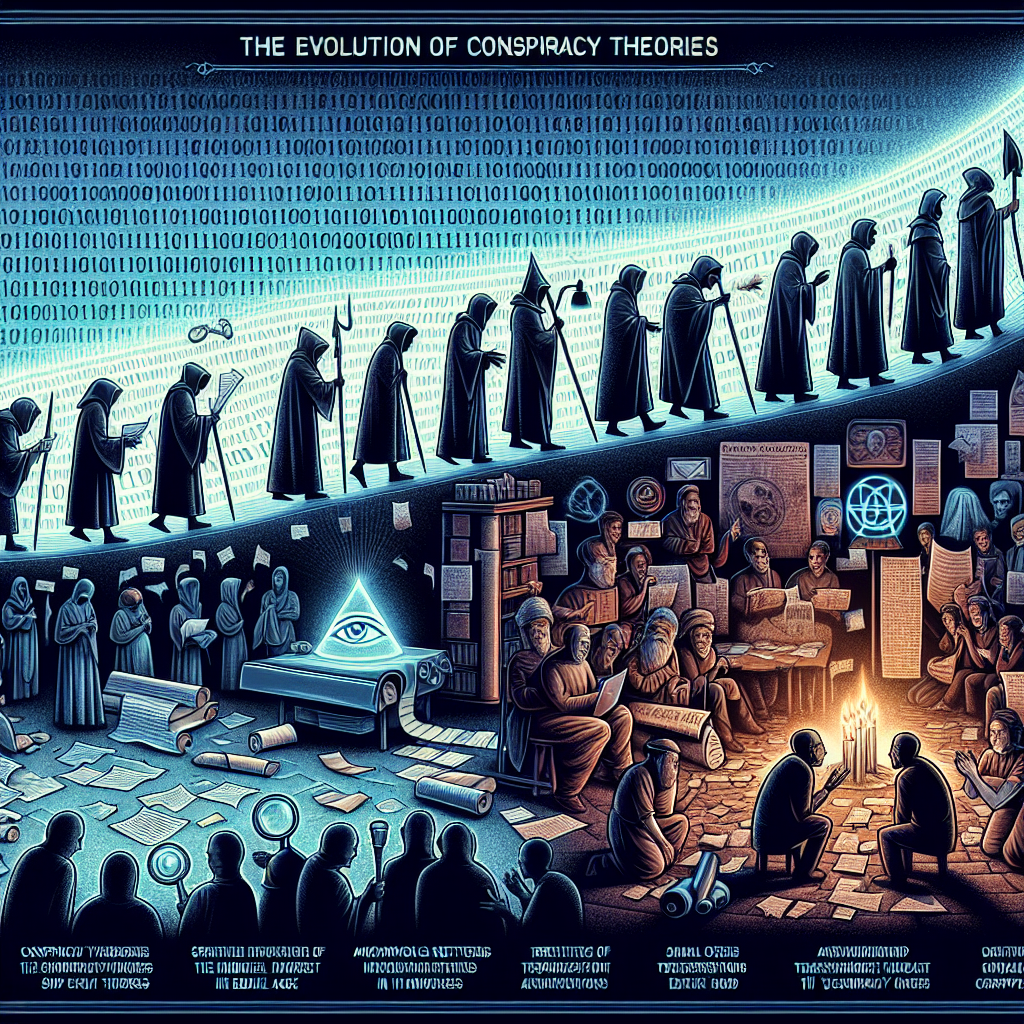
In the shadowy corners of dusty libraries and the electric gleam of digital screens, we find a common thread of intrigue—conspiracy theories. These complex systems of beliefs, theories and improbable causality have woven a fascinating pattern through history, spiralling from the earliest annals of civilisation right up to the digital age. This article aims to unfurl the path this spiral has taken over the centuries, tracing its journey and pondering on the reasons for our continuous, thriving fascination with it.
Conspiracy theories, at their core, relate to alleged secret plans or operations carried out by groups or organisations. They have existed for as long as we have gathered into societies. Ancient historian Suetonius, in his work ‘The Twelve Caesars’, proposed that Emperor Nero started the Great Fire of Rome to make space for his lavish palace, promptly blaming Christians to drown the voices of suspicion^1^.
Fast forward a couple of millenniums; our era is inundated with an array of theories, digital platforms, forums, and social media spurring their creation and dissemination. The digital age has made it much easier for conspiracy theories to spread, magnify, and endure through time.
Conspiracy theories roll out in a riotous spectrum; a colourful expanse that shifts from socio-political conspiracy theories, such as those centred around the Kennedy assassination, to arguably more absurd notions like the advent of ‘lizard people’^2^.
Two primary motivations drive individuals towards conspiracy theories^3^. First, the epistemic motive; the human desire to create and understand the environment around us. Second, the existential motive; the yearning to feel secure and in control. Conspiracy theories often provide simplified solutions to complex, frightening problems or events in the world. They further offer a sense of belonging and community for those who may feel sidelined or alienated.
Professor Viren Swami, a social-psychology researcher, suggests that a dip into conspiracy theories might offer, for many, an echo chamber of shared beliefs and concerns^4^. These echo chambers have only strengthened with the rise of digital platforms, which bypass traditional gatekeeper routes of knowledge distribution like print media, television, or radio.
A stark split exists between sociologists and psychologists studying conspiracy theories. The former often argue that these theories are a rational response to genuine societal concerns, serving upon occasion as a stimulus for social change. Meanwhile, many psychologists view these theories as a reflection of individual pathologies and cognitive limitations^5^.
Analysing the implications of conspiracy theories, their potential impact on social discord, policymaking, and public health is imperative. The COVID-19 pandemic, for example, has showcased the incredible and sometimes dangerous influence conspiracy theories can wield. A Pew research study found that nearly a third of Americans believed the virus was intentionally engineered^6^.
In retrospect, the spiral of conspiracy theories from relics to the digital age is a testament to the interplay of societal dynamics, psychological motivations, technology influence, and cognitive mechanisms. Conspiracy theories, thus, are arguably as much a mirror of society’s fears and anxieties as they are a product of them.
As we continue to delve into the darkness interspersed with flashes of illumination that conspiracy theories offer, several provocative questions linger. Are conspiracy theories ultimately beneficial expressions of societal unease or harmful outgrowths of misinformation? How do we balance the freedom of speech and the spread of erroneous information? While the answers elude simplicity, the questions warrant reflection and exploration on our shared human experience and the complex world we navigate.
^1^ Suetonius. (121 A.D.). “The Twelve Caesars”. Penguin Classics.
^2^ Barkun, M. (2003). “Culture of Conspiracy: Apocalyptic Visions in Contemporary America”. University of California Press.
^3^ Douglas, K. M., Sutton, R. M., & Cichocka, A. (2017). “The Psychology of Conspiracy Theories”. Current Directions in Psychological Science, 26(6), 538-542.
^4^ Swami, V., Chamorro-Premuzic, T., & Furnham, A. (2010). “Unanswered questions: A preliminary investigation of personality and individual difference predictors of 9/11 conspiracist beliefs”. Applied Cognitive Psychology, 24(6), 749-761.
^5^ Bale, J. M. (2007). “Political paranoia v. political realism: on distinguishing between bogus conspiracy theories and genuine conspiratorial politics”. Patterns of Prejudice, 41(1), 45-60.
^6^ Pew Research Center. (2020). “Nearly three-in-ten Americans believe COVID-19 was made in a lab”. pewresearch.org.
For further reading:
- “Conspiracy Theories: A Critical Introduction” by Jovan Byford
- “Conspiracies and Conspiracy Theories in the Age of Trump” by Daniel C. Hellinger
- “Believers: Faith in Human Nature” by Melvin Konner
- “The Paranoid Style in American Politics” by Richard Hofstadter.





 Conversations with AI
Leave a comment