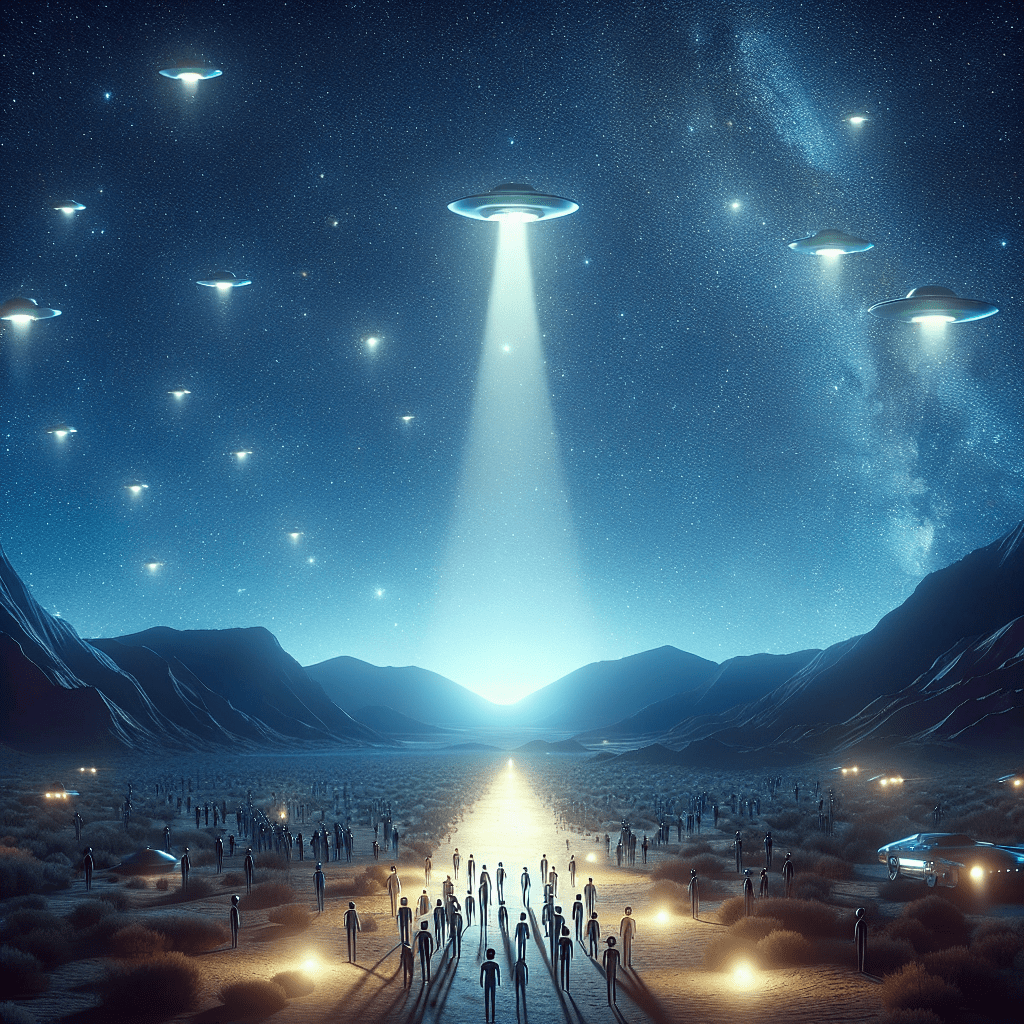
The old adage ‘curiosity killed the cat’ has never been more apt than when it comes to the enigma that is Area 51 and the proliferation of UFO sightings. This insatiable curiosity, piqued over decades of speculation, lore, and secrecy, has transformed an isolated outpost in the Nevada desert into an international symbol of mystery. This article aims to delve into the thrilling nexus of Area 51 and UFO sightings, providing an in-depth exploration of this fascinating topic.
Without any doubt, the allure of Area 51 all begins with its clandestine inception. Known officially as the Homey Airport or Groom Lake, the facility was established in 1955 as the test and development site for the Lockheed U-2, a top-secret and cutting-edge reconnaissance aircraft [1]. Its remote location made it immediately suitable for such confidential manoeuvres, and its high-security perimeter and strict airspace restrictions only fuelled the naturally human predilection for intrigue.
In contrast, the intrigue of UFO sightings has been around for much longer than Area 51. With potential extraterrestrial sightings dating back centuries, one of the first recorded sightings in America occurred in 1639, recorded by John Winthrop, the governor of Massachusetts Bay Colony [2].
Parallel characteristically with Area 51, the UFO phenomenon grew monumentally during the Cold War. Events such as the Roswell Incident in 1947, where a supposed extraterrestrial spacecraft was rumoured to have crashed, propelled the possibility of existence of extraterrestrial life into the mainstream psyche [3]. However, the official explanation was the crash of a weather balloon, and many see the insistence on the supernatural as an example of Cold War paranoia [4].
When you couple the increased interest in UFO’s with the obscurity of Area 51, sparks inevitably fly. A number of alleged UFO sightings over and around Area 51, fuelled by speculative stories and the facility’s clandestine nature, brought both these phenomena onto a global platform under the scanner of mystery, sci-fi, and conspiracy theories.
One of the most notable witnesses is Bob Lazar, who in 1989 claimed to have worked on extraterrestrial technology at a site near Area 51. He alleged the engineering of alien aircraft and even detailed his hands-on experience with an alien reactor [5]. While these claims are unsubstantiated and widely considered controversial, they nonetheless sparked substantial interest in Area 51 and its possible connection with UFOs.
These claims and sightings have had a profound impact on popular culture, and we can’t ignore the societal changes they have brought. From fostering entire genres of science fiction to influencing real-world technical designs, the impacts have been enormous. No less an authority than scientist Dr. Michio Kaku has said, “we owe [science fiction] a huge debt because they are the ones that ignited the spark of curiosity that drives us into the future” [6].
While such cultural impacts are undeniable, it is crucial to bear in mind that many allegations made about Area 51 and UFO sightings are often unsubstantiated. Scientists such as Neil DeGrasse Tyson have argued that UFO sightings are more likely due to ignorance of natural phenomena or secret military projects rather than visitations by extraterrestrial beings [7].
This doesn’t, however, detract from the genuine intrigue and scientific value that the study of UFO sightings represents. Increasingly, reputable scientists advocate for the serious study of Unidentified Aerial Phenomena (UAPs). The Pentagon’s recent classification and admission of such phenomena undoubtedly adds another layer of intrigue to this enduring mystery [8].
In conclusion, Area 51 and UFO sightings represent a compelling chapter in history marked by intrigue, scientific curiosity, and culture. Whilst much is still left unexplained broadening our understanding can lend itself to tantalising possibilities.
Was the paranoia born out of an era marked by nuclear threats, or are there truths waiting to be unveiled? Perhaps further declassification of information, along with continued scientific exploration of UAP, may soon provide more concrete answers.
Here are some references and resources to help sate your curiosity further:
- Pocock, C. R. (2019). 50 Years of the U-2: The Complete Illustrated History of Lockheed’s Legendary Dragon Lady. Atglen: Schiffer Military History.
- Puritans Witness a UFO. (2015). Accessed at: https://www.history.com/this-day-in-history/puritans-witness-a-ufo
- King, G. (1995). The Roswell UFO Crash: What They Don’t Want You To Know. New York: Dell Publishing.
- Kean, L. (2010). UFOs: Generals, Pilots, and Government Officials Go on the Record. New York: Crown Publishing.
- Lazar, B. (n.d.). Bob Lazar: Cosmology. Accessed at: http://www.boblazar.com/closed/reactor.htm
- Kaku, M. (2018). The Future of Humanity: Terraforming Mars, Interstellar Travel, Immortality, and Our Destiny Beyond. New York: Doubleday.
- Tyson, N. D. (2018). Accessory to War: The Unspoken Alliance Between Astrophysics and the Military. New York: Norton & Company.
- Unidentified Aerial Phenomena – National Airspace System. (2020). Accessed at: https://www.dni.gov/files/ODNI/documents/assessments/UAP20210625.pdf





 Conversations with AI
Leave a comment