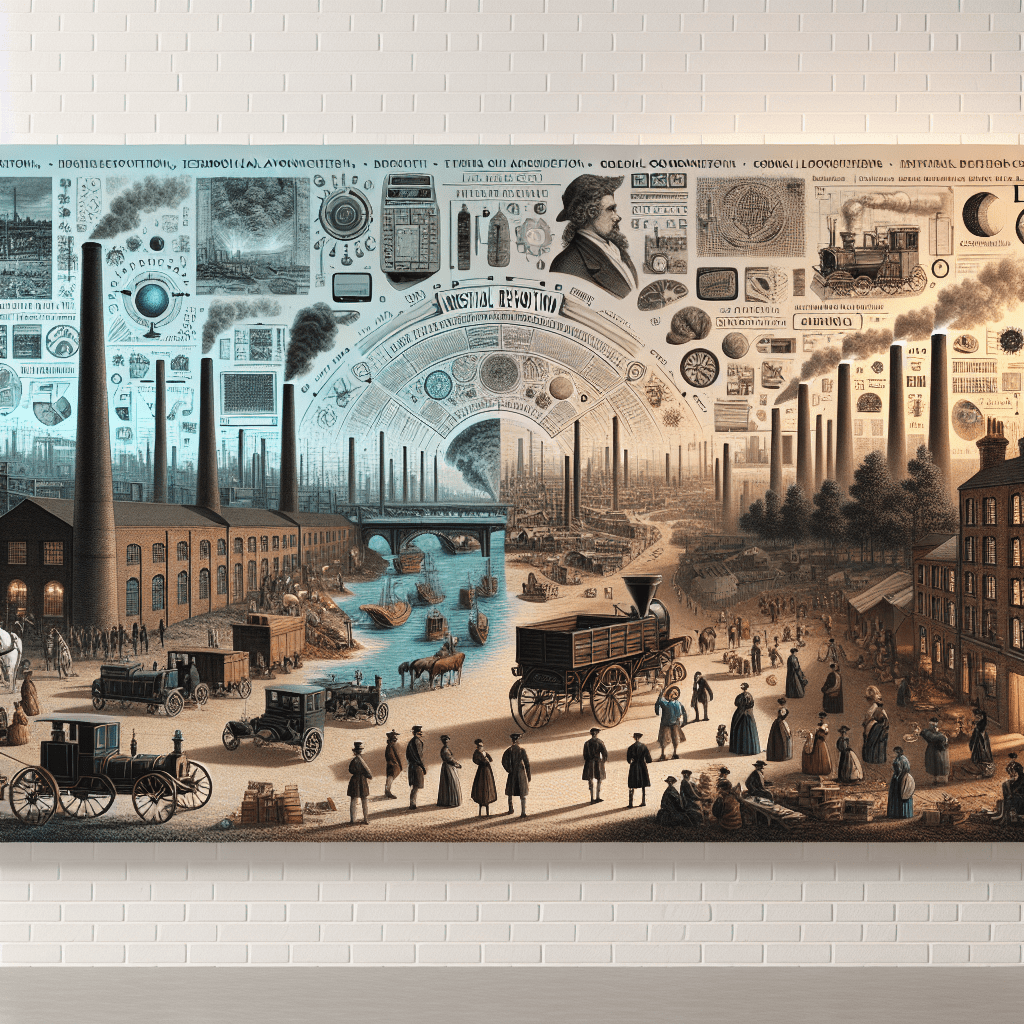
*It was the best of times, it was the worst of times…
The Industrial Revolution, a period of drastic change and significant socio-economic transformation, is undeniably one of the most impactful periods in human history. The purpose of this article is to delve into this epoch-making era, examining its roots, its global impacts and the perennial relevance it holds in our contemporary society. This discussion will span a timeline from the late 1700s through to the early 19th century – an era that forever altered how we work, live and communicate.
Before the Industrial Revolution, much of the world’s populace lived in rural areas, largely self-reliant and sustaining themselves through agriculture. However, beginning in Britain around 1760, a surge of technological breakthroughs led to the creation of machinery capable of mass production. This flurry of innovation swiftly spread to Western Europe, North America and eventually the rest of the world.
Key events and technological advancements triggered the revolution. In 1698, Thomas Savery invented the first steam engine, a rudimentary version designed for water pumping. In 1751, Benjamin Franklin demonstrated that lightning was a form of electricity, paving the way for electrical power. In 1764, James Hargreaves devised the Spinning Jenny, and Richard Arkwright spearheaded the development of the water-powered frame, tools that revolutionised the textile industry. These milestones, among others, set in motion a seminal shift in global development.
The Industrial Revolution can be dissected into various themes: the transformation of labour and production, societal changes, global impacts and the formation of new social attitudes towards labour, industry and capital.
Transformation of Labour and Production: The hallmark of the revolution was the shift from hand production methods to machines. Factories became the locus of production, powered by steam and then electricity. This fundamentally changed how goods were produced, dramatically increasing output and efficiency.
Societal Changes: The population gravitated towards urban areas, drawn by factory jobs offering stable income. This led to the growth of cities, significant demographic changes and the creation of a new social class – the industrial proletariat.
Global Impacts: The technology and ideas born from the revolution quickly spread globally. Countries adopted mechanised production, leading to a surge in global trade. The industrialising nations began to exert significant influence on global politics, economics and culture.
New Social Attitudes: The economic surge led to new attitudes towards wealth, social status and the role of government in regulating industry. Utilitarianism emerged, advocating for the greatest good for the greatest number of people and capitalism found its footing, characterised by private ownership and competitive markets.
Historian Eric Hobsbawm states, “Whoever says Industrial Revolution, says cotton.” The textile industry was indeed at the forefront of the revolution. The inventions of the spinning jenny, power loom, and cotton gin contributed to a boom in textile production, and thus, it is widely agreed that the industry was a major precipitating factor of the revolution. Robert C. Allen, a Professor of Economic History, wrote in The British Industrial Revolution in Global Perspective that the revolution was driven by Britain’s uniquely advantageous wage and resource structures.
The Industrial Revolution, teeming with transformative technological revolutions, drastically altered global living conditions. It saw a significant rise in living standards for many, but a decline for others. Child labour, exploitative working conditions and environmental deterioration marked the era, fostering a milieu for social reforms and movements.
The long-term effects have been profound and far-reaching. Global wealth distribution, the surge of capitalism, the growth of cities and the international division of labour all have their roots in the revolution. Today, we are arguably experiencing its continuation with the digital revolution, underpinning our globalised and interconnected world.
Ultimately, the Industrial Revolution was a complex, multifaceted period that profoundly reshaped the world. It was a time of great progress and significant challenges, whose impacts are still widely felt and studied today. As we grapple with the Fourth Industrial Revolution – the digital transformation – we must reflect on the lessons from the first revolution to successfully navigate the future. As the next chapter unfolds, one must ask – are we equipped to handle the changes ahead?
References and Further Reading
1. Hobsbawm, E. (1999). Industry and Empire: From 1750 to the Present Day. New Press.
2. Allen, R. C. (2009). The British Industrial Revolution in Global Perspective. Cambridge University Press.
3. More, C. (2000). Understanding the Industrial Revolution. London: Routledge.





 Conversations with AI
Leave a comment