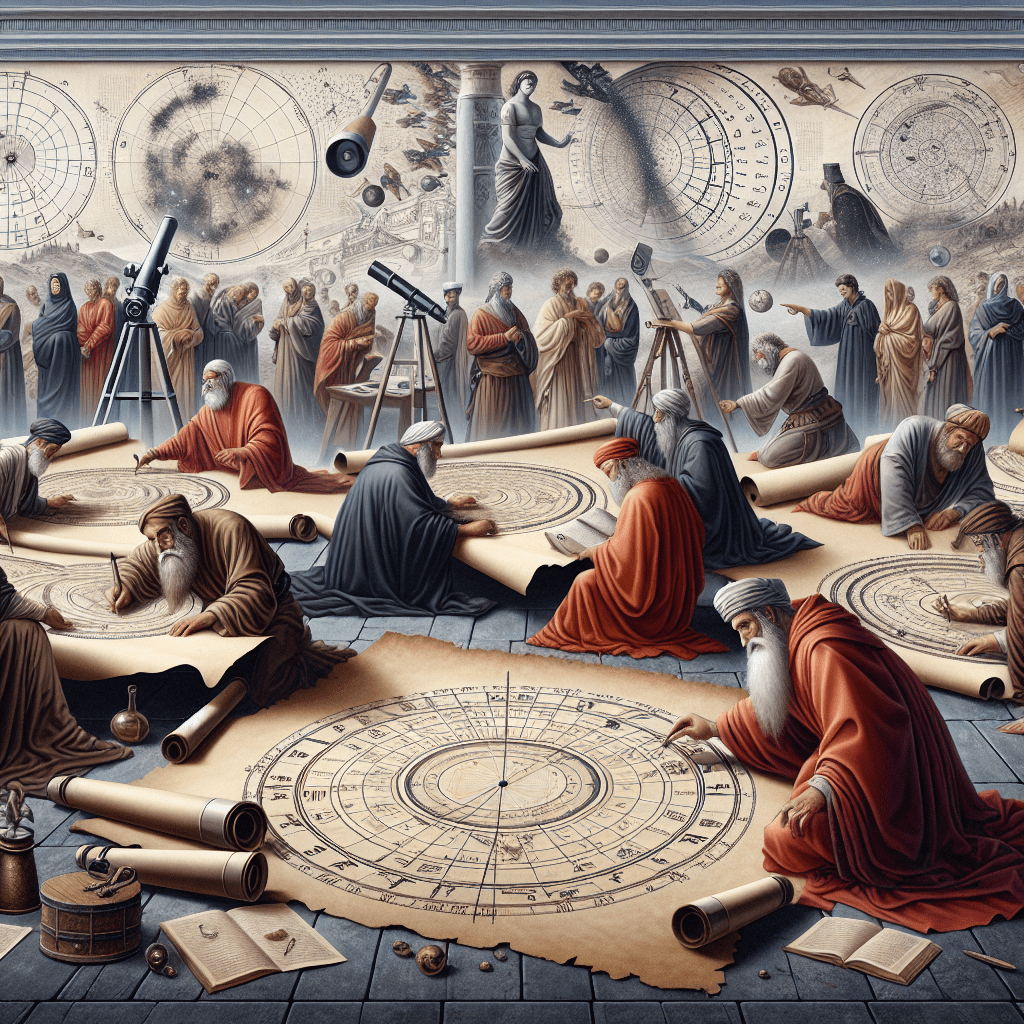
From ancient times to the modern era, we, as humans, have always been fascinated by the celestial bodies in our sky. This fascination has sparked a long-standing discussion about astrology and astronomy: are these realms of science or pseudoscience? This article delves into the dichotomy between these two disciplines, it explores their historical development, key concepts, controversies and their implications on society.
Background and Context
Both astrology and astronomy originated from the same ancient study of celestial bodies. For many centuries, these disciplines were not separate entities; instead, they were unified, with scholars typically being well-versed in both. It was not until the 17th century, with the scientific revolution, that astronomy diverged from astrology to emerge as its individual scientific discipline. The timeline below provides an exploration of significant milestones in the development of both fields.
Timeline and Significant Events
2nd millennium BC: Ancient Babylonians develop some of the earliest forms of astrology.
4th Century BC: The Greeks begin practicing astrology, essentially inheriting it from the Babylonians.
2nd Century AD: Ptolemy, a Roman citizen of Egypt, writes the Tetrabiblos, an influential work solidifying the principles of astrology.
16th – 17th centuries: The scientific revolution triggers a major shift. Astronomers like Galileo Galilei, Johannes Kepler, and Isaac Newton contribute to the separation between scientific astronomy and astrology.
Main Discussion Points
To understand the debate between astrology and astronomy, it’s important to clarify what each field entails and how they differ from each other.
Astronomy
Astronomy is a scientific study of celestial bodies: their composition, properties, movements and the processes surrounding them. Using various methodologies and experimental data, astronomers work to understand the cosmos from a physical standpoint. This discipline has seen significant advancements in technology, particularly the telescope, which has allowed scientists to explore the mysteries of the universe in greater detail.
Astrology
On the other hand, astrology is the practice of interpreting celestial movements with the belief that they can influence human behaviour and worldly events. Astrologers maintain that the position of the planets at the time of one’s birth correlates with personality traits and can even foretell future events. This practice, however, is often deemed pseudoscientific since it lacks consistent methodologies and empirical evidence to support its claims.
Cross-Referenced Statements and Quotes
The debate around the scientific merit of astrology has been disconcertingly polarised. According to Neil deGrasse Tyson, a renowned astrophysicist, “Astrology was the first to be developed, mostly to satisfy people’s quest to know the future. Astronomy came later, and it has been the most significant scientific discipline for our understanding the cosmos.”[1]
Conversely, astrologer and psychology professor, Glenn Perry, argued, “Astrology provides a richly detailed symbol system that corresponds with human experience, it is a valid and useful psychological tool.”[2]
Analysis and Implications
The divisions that separate astrology and astronomy indicate the contrasting relationships each field has with the scientific community. While there’s a broad consensus accepting astronomy as a science, astrology is often dismissed as pseudoscience due its lack of empirical evidence.
However, despite this dismissal, astrology remains prevalent in many cultures and continues to influence people’s lives. It’s worth noting that science isn’t the only framework through which we glean understanding or find personal significance. While astronomy quantifies the universe’s physical nuances, astrology can offer some a qualitative understanding of their place within it.
Conclusion
Whether seen as a science or pseudoscience, astrology and astronomy both remain integral parts of how human culture interacts with the celestial realm. Do these fields serve separate purposes, with one providing objective knowledge and the other offering subjective meaning? Or should the qualitative value of astrology be reconsidered within our scientific understanding? Astrology’s contribution is something worth pondering.
References
[1] Tyson, N. (2017). Astrology vs Astronomy. StarTalk Radio. Retrieved from http://www.startalkradio.net
[2] Perry, G. (2015). The Case for Astrology. The APA Journal. Retrieved from http://www.apa.org
Further Reading
– A History of Astronomy from Thales to Kepler. Dover Publications (1990), by J. L. E. Dreyer.
– Cosmos and Psyche: Intimations of a New World View. Penguin (2007), by Richard Tarnas.
– Astrology, Science and Culture: Pulling down the Moon. Berg Publishers (2004), by Roy Willis and Patrick Curry





 Conversations with AI
Leave a comment