
*Wont be long until the year 11s are having to sit tests, can chatGPT help with revision?
can you test me with a mock GCSE english please? can you give me questions that include expected marks, then can you mark them out of those grades please?
Absolutely! Here’s a mock GCSE English Language test, similar to what you might expect in an exam. I’ll include mark schemes and criteria for each question, and after you complete the tasks, I’ll mark your responses based on the provided guidelines.
Section A: Reading (40 marks total)
Question 1: Language Analysis (10 marks)
Read the extract below and answer the question that follows:
“The rain poured relentlessly, drumming on the roof like a thousand tiny feet. Trees bowed under the weight of the wind, their branches creaking and snapping like brittle bones. The house stood isolated, the lights flickering inside as if they too were trembling under the storm’s wrath. Inside, she stood by the window, staring out into the night, her breath fogging the glass. She shivered, though the fire burned brightly in the hearth.”
How does the writer use language to create a sense of unease in this extract?
- Marks Available: 10
- 0-3 marks: Basic understanding, with limited or no explanation of language use.
- 4-6 marks: Some explanation of language features, with a focus on creating unease.
- 7-10 marks: Detailed and insightful analysis of specific language techniques, clearly linked to the sense of unease.
Question 2: Summary (8 marks)
Read the following two extracts. Summarise the similarities between how the two characters are feeling.
Extract A:
“The crowd swelled around him, a mass of bodies moving in every direction. He felt as though he were drowning in noise, the shouts and laughter too loud in his ears. His heart pounded in his chest, and his palms were slick with sweat. All he wanted was to escape, to find a quiet place where he could think.”
Extract B:
“She sat in the back of the classroom, her head down, hoping no one would notice her. The others laughed and whispered, passing notes back and forth, but she felt completely separate from them. Her hands shook as she fiddled with her pen, the air in the room thick with a sense of her own isolation.”
- Marks Available: 8
- 0-2 marks: Simple statements about the texts with little or no focus on feelings.
- 3-5 marks: Some understanding of the similarities in the characters’ feelings, but lacking detail.
- 6-8 marks: Clear and detailed summary of the similarities, showing perceptive understanding of both extracts.
Question 3: Comparing Writers’ Ideas (12 marks)
Both of the following extracts deal with the theme of disappointment. Compare how the two writers present disappointment in their texts.
Extract A:
“For weeks, she had planned the trip in her mind—how perfect it would be, how happy she would feel standing at the top of the hill, watching the sun set. But now, as she reached the summit, all she could see was a thick blanket of fog that covered everything. The sky was a dull grey, and the wind whipped her hair into her eyes. She stood there, her heart sinking, feeling nothing but a hollow sense of loss.”
Extract B:
“When he opened the envelope, his hands trembled with anticipation. For days, he had imagined the joy of reading the acceptance letter, of seeing his name printed there in bold letters. But now, as he scanned the page, all he saw were the words: ‘We regret to inform you…’. His throat tightened, and he felt a deep ache in his chest as the weight of his disappointment settled heavily on his shoulders.”
- Marks Available: 12
- 0-3 marks: Basic comparison, with limited or no detail.
- 4-6 marks: Some comparison, identifying relevant ideas about disappointment.
- 7-9 marks: Thoughtful comparison, with some analysis of how disappointment is presented in both texts.
- 10-12 marks: Perceptive and detailed comparison, with clear and insightful analysis of both extracts.
Section B: Writing (40 marks total)
Question 4: Descriptive Writing (40 marks)
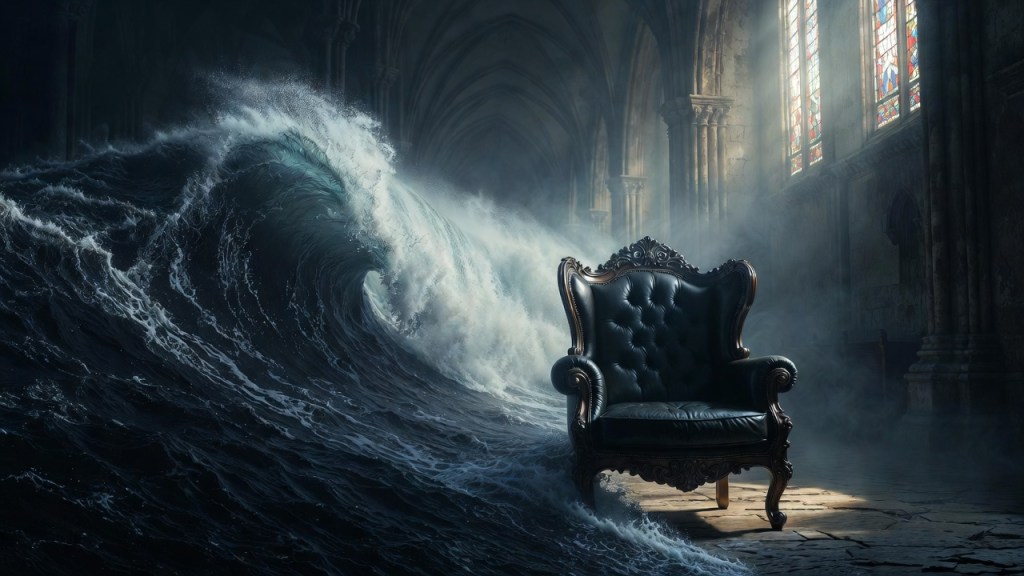
Write a description of a place during a storm as suggested by this image:
(Imagine a place during a storm – could be a forest, city street, or isolated house. Use vivid description to bring it to life.)
- Marks Available: 40
- 0-15 marks: Basic description with limited structure and detail.
- 16-25 marks: Some engaging description and structure, with developing use of imagery.
- 26-35 marks: Consistently engaging and well-structured, with effective use of imagery and detailed description.
- 36-40 marks: Highly effective, creative, and original, with sophisticated use of language and imagery.
Marking and Feedback:
Once you’ve completed the questions, submit your answers here, and I’ll mark them according to the criteria provided. You’ll receive detailed feedback, and I’ll also assign marks for each question.
Good luck!
the writer creates unease in the paragraph in a number of ways. they mention the relentlessness of the rain, making the reader feel that there would be no stopping it. The rain drummed the roof like a thousand feet making it seems as if there were many people fighting to get in. The wind broke the brittle branches of the tree, they used brittle to describe the branches as weak and unable to withstand the force of the wind. The house was on its own – isolated, the lights trembled under the storms wrath, using personification with the word wrath, the wind doesn’t fee; emotion. The female shivered, but not from the lack of heat from the fire that burned brightly in the hearth, suggesting she shivered from the fear of the storm.
Great response! Let’s assess your answer using the mark scheme for Question 1 (Language Analysis, 10 marks):
Marks Breakdown:
- 0-3 marks: Basic understanding with limited or no explanation of language use.
- 4-6 marks: Some explanation of language features, with a focus on creating unease.
- 7-10 marks: Detailed and insightful analysis of specific language techniques, clearly linked to the sense of unease.
Feedback:
- You identify key techniques like personification (“wrath”) and imagery (“a thousand feet”), which shows a clear understanding of how the writer uses language to create unease.
- You explore the relentlessness of the rain and isolation of the house, explaining how these elements contribute to the mood.
- The observation that the woman shivers not from the cold but from fear is insightful, as it directly links physical reactions to emotional unease.
- Your explanation of the brittle branches and the personification of the storm are well-explained and show a thoughtful engagement with the text.
Improvements:
- You could add even more specific examples of language techniques (e.g., the use of metaphors, the alliteration in “brittle branches”) and provide slightly more depth in explaining how these techniques contribute to the overall tension and unease.
- You have a strong understanding, but making connections between the reader’s emotional response and the specific language choices would elevate your answer further. For example, how might the “isolated” house make the reader feel vulnerable?
Mark: 8/10
You’ve provided a thoughtful and clear analysis with good engagement with the text. A little more depth in linking language techniques to the reader’s response would push you towards the higher end of the mark range.
Great work overall!
*I got 8/10 for the first question! Probably the best I’ve ever done. I’ll carry on with a using the same question as asked for the mock test, but this time with GCSE Science
can you test me on a mock GCSE science please? can you give me questions that include expected marks, then can you mark them out of those grades please?
Sure! I’ll create a mock GCSE science test with some typical questions. For each question, I’ll include the marks allocated, and after you submit your answers, I can mark it for you.
GCSE Science Mock Test
Section 1: Biology (15 marks)
Q1. (3 marks)
What is photosynthesis, and what are the main components required for this process to occur?
Q2. (2 marks)
Describe the difference between aerobic and anaerobic respiration.
Q3. (3 marks)
Explain how the human circulatory system is adapted to transport substances around the body.
Q4. (4 marks)
Explain the process of natural selection. Use an example of an animal to support your answer.
Q5. (3 marks)
Name three different types of pathogens and explain how they can be transmitted.
Section 2: Chemistry (15 marks)
Q6. (3 marks)
What are the three states of matter, and describe the particle arrangement for each?
Q7. (3 marks)
Explain what happens during a chemical reaction in terms of atoms and energy.
Q8. (2 marks)
What is the pH scale, and how does it relate to acids and alkalis?
Q9. (4 marks)
Describe how the periodic table is organized, and explain the trends you might observe going across a period and down a group.
Q10. (3 marks)
What is the difference between an element, a compound, and a mixture? Give an example of each.
Section 3: Physics (15 marks)
Q11. (3 marks)
Explain Newton’s First Law of Motion with an example.
Q12. (2 marks)
What is the difference between speed and velocity?
Q13. (4 marks)
Describe the energy transfers that occur when a ball is thrown into the air and then falls back to the ground.
Q14. (3 marks)
What is the difference between renewable and non-renewable energy sources? Give an example of each.
Q15. (3 marks)
Define work done and state its formula. How is work related to energy?
Total marks: 45
Submit your answers, and I’ll mark them for you!
photosynthesis is the process by which sunlight is converted into energy / glucose. the main components are, sunlight, that is captured by chlorophyll. Water which is absorbed by plant roots and is split into oxygen and hydrogen through the process. Carbon dioxide, water and sunlight are all combined to create glucose with oxygen as a by product of the reaction.
Great! Let me mark your response to Q1.
Marking for Q1: (3 marks)
Question: What is photosynthesis, and what are the main components required for this process to occur?
Expected Answer Breakdown:
- 1 mark for correctly defining photosynthesis as the process by which plants use sunlight to produce glucose/energy.
- 1 mark for mentioning the main components required: sunlight, water, and carbon dioxide.
- 1 mark for the correct description of the product (glucose) and by-product (oxygen).
Your Response:
You correctly explained photosynthesis as the process where sunlight is converted into energy (glucose). You also mentioned the components: sunlight, water (absorbed by plant roots), and carbon dioxide, and you explained the splitting of water and formation of glucose and oxygen as a by-product.
Marking:
- Definition: ✔️ (1 mark)
- Components: ✔️ (1 mark)
- Products: ✔️ (1 mark)
Total for Q1: 3/3 marks
Well done! You got full marks on this question. Feel free to proceed with the rest of the questions.
*Photosynthesis is about all I remember. I’ll carry on with computing, I should be able to do this, surely!
can you test me on a mock GCSE computing please? can you give me questions that include expected marks, then can you mark them out of those grades please?
Sure! I can create a mock GCSE Computing test for you. I’ll provide the questions along with the marks allocated to each, and after you answer, I’ll mark your responses according to the marks available.
Here’s a mix of topics that might come up in a GCSE Computing exam:
Mock GCSE Computing Exam
Section 1: Computer Systems
1. Explain what is meant by the term ‘CPU’ and describe its main functions.
(3 marks)
2. What is the purpose of RAM in a computer system?
(2 marks)
3. Compare and contrast the use of solid-state drives (SSD) and hard disk drives (HDD). Give two advantages and one disadvantage of each.
(6 marks)
Section 2: Programming and Algorithms
4. Write pseudocode for an algorithm that takes two numbers as input, adds them together, and outputs the result.
(3 marks)
5. Explain the concept of a ‘loop’ in programming and give an example where a loop might be used in a program.
(4 marks)
Section 3: Data Representation
6. Convert the binary number 1100101 into decimal.
(2 marks)
7. Explain what ASCII is and why it is used in computing.
(3 marks)
Section 4: Networks
8. What is a computer network and why is it useful?
(2 marks)
9. Explain the difference between a LAN (Local Area Network) and a WAN (Wide Area Network).
(2 marks)
Section 5: Cybersecurity
10. Define the term ‘phishing’ and explain how it can be prevented.
(4 marks)
Please answer the questions, and I’ll mark your responses out of the provided marks. Let me know if you need clarification on any question!
the CPU processes all the fundamental operations of a computer, it handles everything from complex calculations to basic data manipulation
Great start! Here’s the breakdown of your response for Question 1:
1. Explain what is meant by the term ‘CPU’ and describe its main functions.
(3 marks)
Marking Criteria:
- 1 mark for defining the CPU (Central Processing Unit).
- 1 mark for mentioning that the CPU performs calculations/processing tasks.
- 1 mark for explaining that it controls/manages data or programs.
Your answer:
- “The CPU processes all the fundamental operations of a computer” – This touches on the core role of the CPU. (1 mark)
- “It handles everything from complex calculations to basic data manipulation” – You’ve mentioned calculations and data manipulation, which aligns with the processing tasks. (1 mark)
However, you missed explaining that the CPU controls or manages the execution of programs, or the flow of data between other components (e.g., memory, input/output).
Final Mark: 2/3
Feel free to answer the next questions!




 Conversations with AI
Leave a comment